Deutsch
 Türkçe
 Italiano
 Nederlands
 Français
 Español
 Polski
 Čeština
 Svenska
 Português PT
 Русский
 اللغة العربية
 中文
 日本語
 Tiếng Việt
 ภาษาไทย
 Română
 ελληνικά
 Magyar
 Dansk
 Suomi
 Hrvatski
 български език
 Eesti keel
 Latviešu valoda
 Slovenčina
 Slovenščina
 Bosanski
 עברית
 हिन्दी
 Bahasa melayu
 Kiswahili
 Bahasa Indonesia
 Papiamento
 Bokmål
 Lietuvių kalba
 Українська
 српски
 Shqip


 ›
 ›
 ›
 ›
 ›
 ›
 ›
 ›
 ›
 ›
 ›
 ›
 ›
 ›
 ›
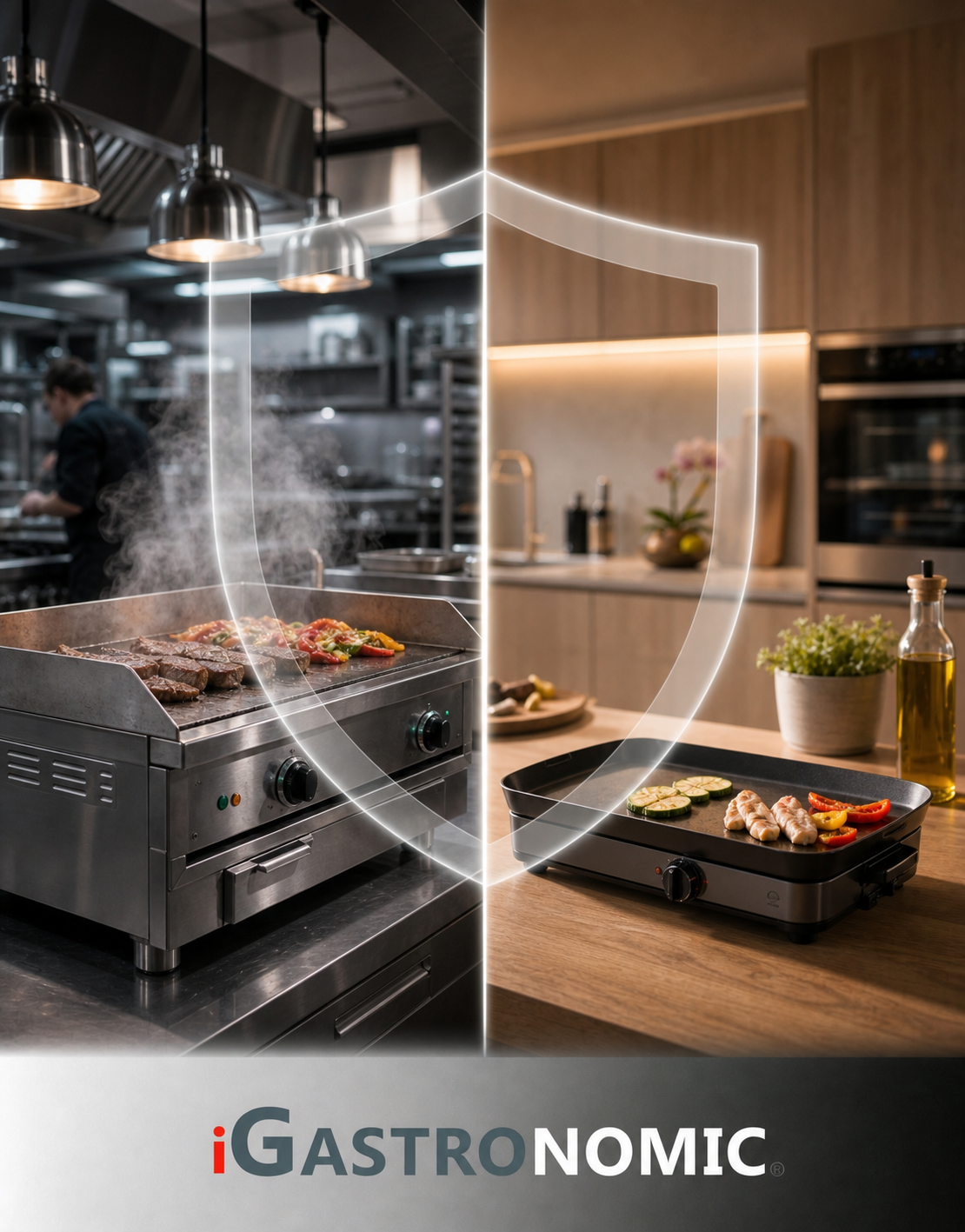
In short: A professional Fry-Top (commercial flat top griddle) is worthwhile for foodservice businesses and heavy use, while a household Fry-Top suits occasional cooking at home. Professional units offer thicker plates, higher output, larger cooking surfaces and a longer service life, whereas home models are more compact and less expensive. The key factors are frequency of use, volume, connection (electric or gas) and budget.
What is a Fry-Top?
A Fry-Top is a large, flat griddle plate for frying, grilling and keeping food warm. The surface is usually made of steel or cast iron; commercial units often have a chrome-plated steel surface. It distributes heat evenly.
Unlike frying pans or a classic grill, a Fry-Top allows several foods to be cooked at the same time across a large surface. This is why it is an indispensable tool in professional kitchens for fast, efficient workflows. More and more home cooks are also discovering its benefits for their own kitchens.
Professional Fry-Top: Features and Benefits
Professional Fry-Tops are designed specifically for use in foodservice. They are distinguished by quality, robustness and high performance.
Material and Build Quality
Commercial models usually have a thick plate made of steel or cast iron that conducts and stores heat well. The construction is designed for the demands of intensive daily kitchen operation with long operating hours.
Size and Output
These units are often larger than household models and offer a significantly bigger cooking surface. Their heating output is also higher, enabling rapid heat-up and even cooking, even at high throughput.
Temperature Control
Professional Fry-Tops usually have precise temperature controls, often infinitely variable. This is important for cooking a wide range of foods optimally, from burgers to fish.
Cleaning and Maintenance
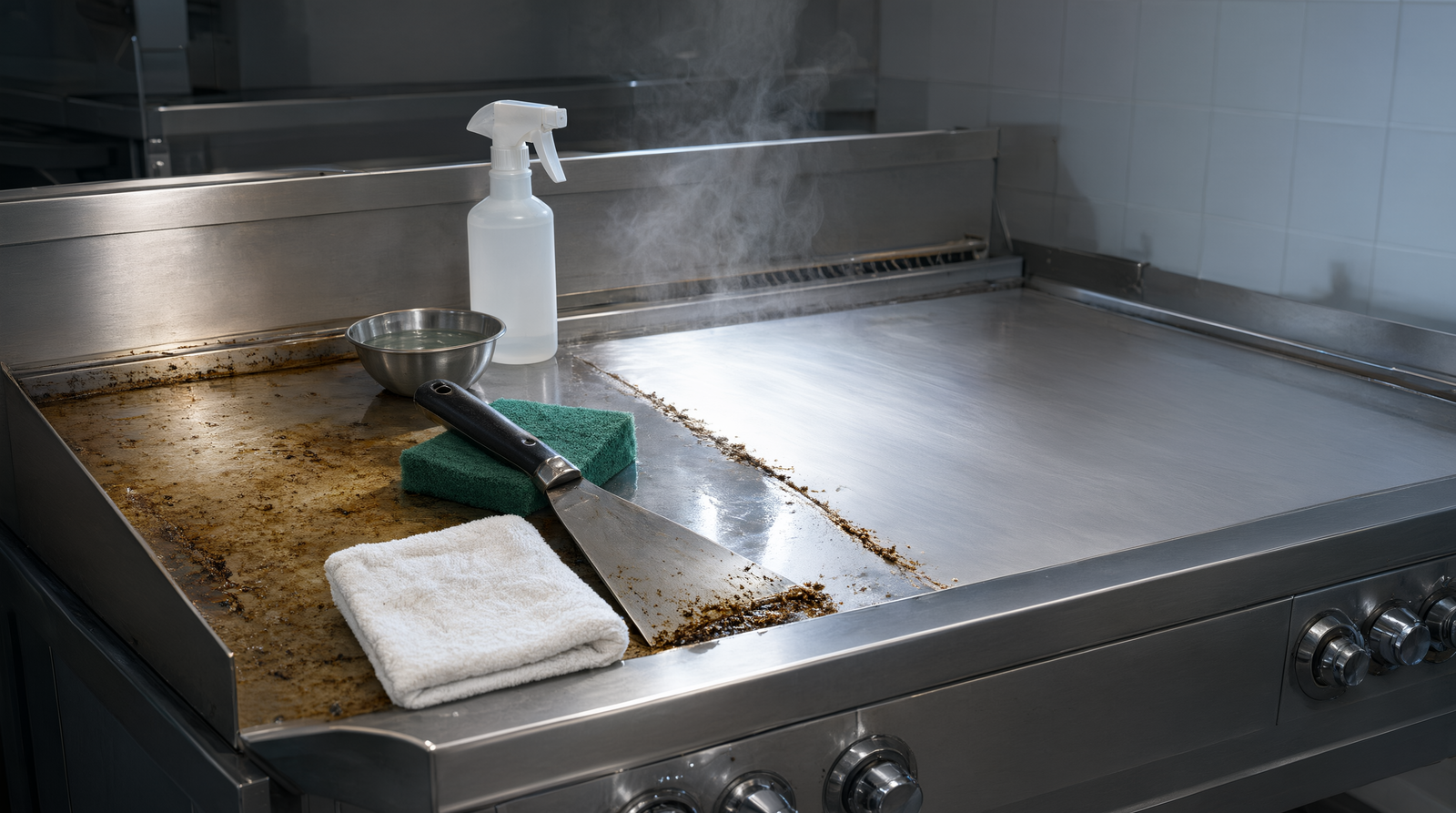
Cleaning is designed for frequent use. Many units have removable grease trays and smooth surfaces, so residue can be easily scraped off with a spatula.
Price and Cost-Effectiveness
The purchase price is significantly higher than that of household models. The investment is mainly worthwhile for foodservice businesses and ambitious home cooks who cook regularly and in larger quantities, because the units last a very long time with proper care.
Household Fry-Top: Features and Limitations
Household Fry-Tops are designed for private use. They are more compact, less expensive and often easier to operate.
Material and Build Quality
They are often made of thinner steel or aluminium with a non-stick coating. This makes them lighter, but less robust than professional units.
Size and Output
The cooking surface is smaller, which is usually sufficient for home use. The lower heating output keeps power consumption down, but limits heat-up time and throughput.
Temperature Control
Many household models have simple controls or preset heat levels. As a result, the temperature is less precisely controlled than on professional units.
Cleaning and Maintenance
Thanks to the non-stick coating, these models are often easy to clean. However, they are more sensitive to scratches, sharp tools and heavy use.
Price
Household models are significantly less expensive and therefore attractive to many households. They offer good value for money for occasional use.
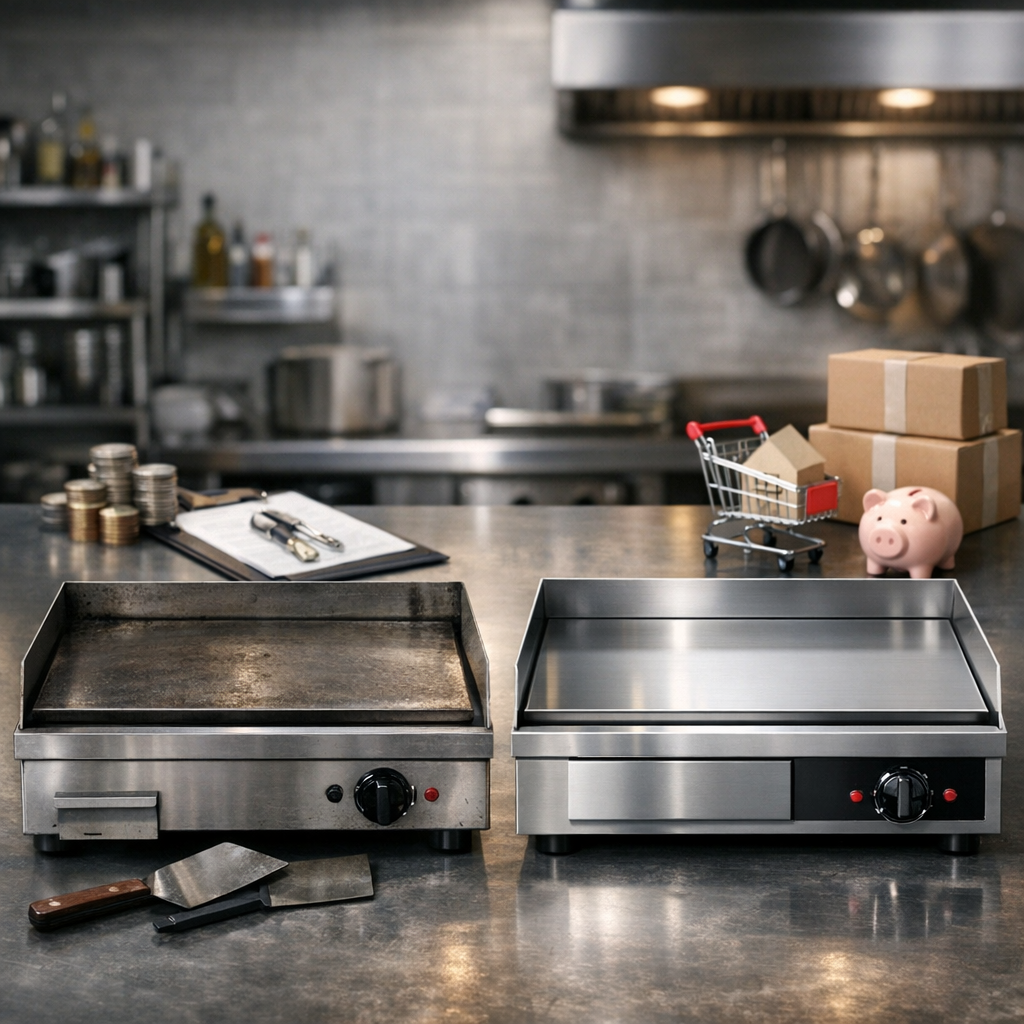
Comparison: Professional Fry-Top vs. Household Fry-Top
The following table shows typical reference values. Actual specifications vary depending on the model.
| Criterion | Professional Fry-Top | Household Fry-Top |
|---|---|---|
| Material | Thick steel, cast iron or chrome-plated plate | Thin steel or aluminium with non-stick coating |
| Size | Large (up to 100 cm width or more) | Compact (approx. 30–50 cm width) |
| Output | High, rapid heat-up, high temperatures | Medium to low, sufficient for home use |
| Temperature control | Precise, often infinitely variable | Simple, usually in steps |
| Connection | Often three-phase power (400 V) or gas | Usually a standard household socket |
| Cleaning | Easy thanks to smooth plate and grease tray | Easy thanks to non-stick coating, but scratch-sensitive |
| Purchase price | Significantly higher | Low to medium |
| Service life | Very long with proper care | Limited, depending on use and care |
Which Model Suits Whom?
Professional Fry-Top
- Foodservice businesses: Restaurants, snack bars and catering companies benefit from high output and robustness.
- Ambitious home cooks: Anyone who cooks frequently and in larger quantities benefits from the advantages of a professional unit.
- Durability and investment: If you are looking for a long-lasting unit and are prepared to invest more, a professional Fry-Top is a good choice.
Household Fry-Top
- Occasional use: For normal household cooking, such as burgers, vegetables or breakfast dishes.
- Limited budget: If you want a good unit at a low price, a household model is a sensible choice.
- Space-saving: Small kitchens benefit from compact models that are easy to store.
What Should You Look Out for When Buying?
Whether you choose a professional or a household model, these criteria should be checked before you buy.
Size of the Cooking Surface
Consider how many guests or people you will be cooking for and how much space you have available. For small households a smaller model is usually sufficient; professionals plan the surface according to peak times. With the free 3D kitchen planner you can check in advance whether the unit fits your kitchen.
Heat Source
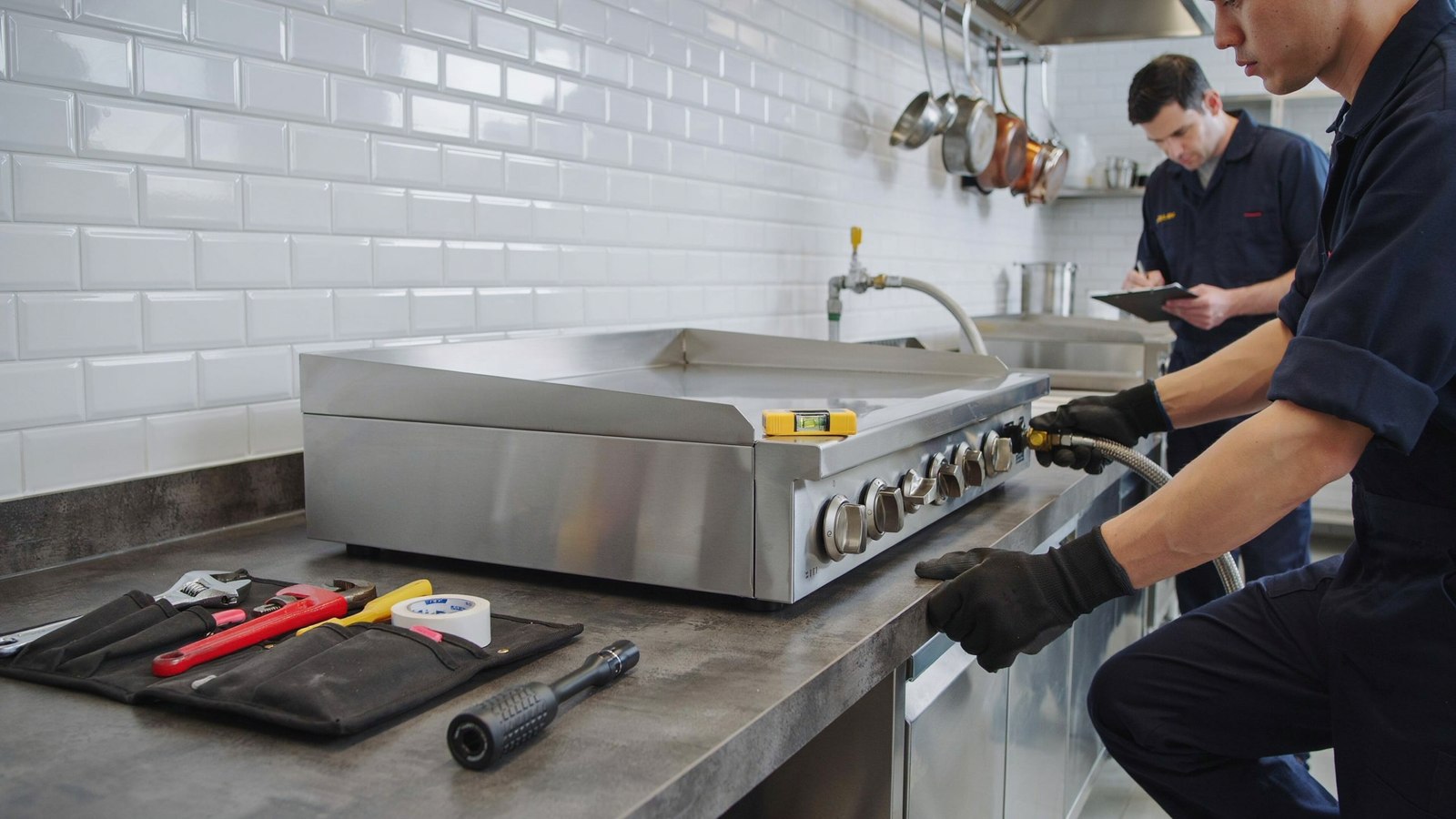
Fry-Tops are available with electric, gas or induction heating. Electric models are easy to operate and flexible in placement, while gas often offers more output and flexibility. An electric griddle with drip tray and 400 V is suitable for kitchens with a three-phase power connection, and a gas griddle with smooth chrome plate is suitable for businesses with a gas connection. Gas and three-phase connections should be installed by a qualified professional.
Temperature Control
Precise control is important for cooking different foods optimally. Look for infinitely variable controls or several heat settings, and on larger units, separately controllable heating zones.
Material and Surface
A high-quality steel, chrome or cast iron plate lasts longer and delivers better grilling results. Smooth plates are suitable for burgers, eggs and pancakes, while grooved surfaces create grill marks on meat and vegetables. Non-stick coatings make cleaning easier but can be damaged if not handled properly.
Cleaning and Maintenance
Removable grease trays and smooth surfaces simplify cleaning. Check whether the unit can be easily disassembled and serviced.
Energy Consumption and Value for Money
Set a budget and compare features and quality within that price range. Also factor in running costs: the energy cost calculator for commercial kitchen equipment helps you estimate consumption.
Conclusion
The choice between a professional and a household Fry-Top depends on your needs. For occasional use at home, an affordable, compact model is usually sufficient. If you cook regularly and in larger quantities, or are looking for a durable, high-performance unit, a professional Fry-Top is the better choice.
Before buying, define your requirements such as surface area, connection and frequency of use, and compare the units carefully. The personal advice from iGastroNomic can help you choose – free of charge and without obligation.
FAQ – Frequently Asked Questions
Can a professional Fry-Top also be used at home?
In principle, yes. However, professional models are larger, heavier and more expensive than household units. They also often require a special connection, such as three-phase power (400 V) or gas, which should be installed by a qualified professional. Therefore, check the space required, connection options and load capacity of the work surface in advance before using a commercial unit in a private home.
How do I clean a Fry-Top properly?
Clean the plate while it is still warm: scrape off food residue and grease with a spatula, push it into the grease tray and then wipe with a damp cloth. Avoid aggressive cleaning agents and sharp tools, especially on non-stick coatings or chrome surfaces. Also follow the manufacturer's care instructions.
Is a Fry-Top safe for health?
When used as intended, units made from food-safe materials are considered suitable for food preparation. Make sure surfaces are food-safe and undamaged, avoid overheating and replace heavily scratched non-stick coatings. For binding statements on hygiene and health requirements in your business, contact your local food safety authority.
Which foods can be prepared on a Fry-Top?
Almost anything that can be fried or grilled: burgers, steaks, fish, vegetables, eggs, pancakes, bacon or sandwiches. Thanks to the large surface, you can cook several ingredients at once, including at different temperatures if the unit has separately controllable heating zones. This makes it possible to prepare breakfast, snacks and à la carte dishes quickly and efficiently.
Are there differences in power consumption?
Yes. Professional electric Fry-Tops usually have a higher connected load and often require a 400 V connection. Household units are smaller and generally draw less power. Actual consumption, however, depends on heating time, load and temperature control. Calculating running costs is especially worthwhile for continuous operation.