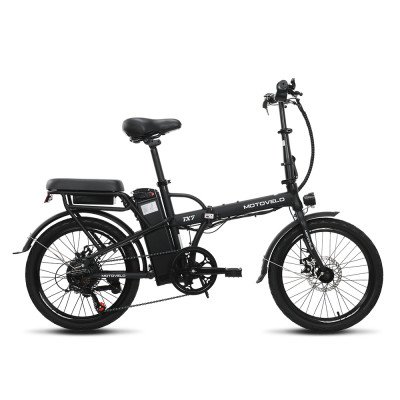
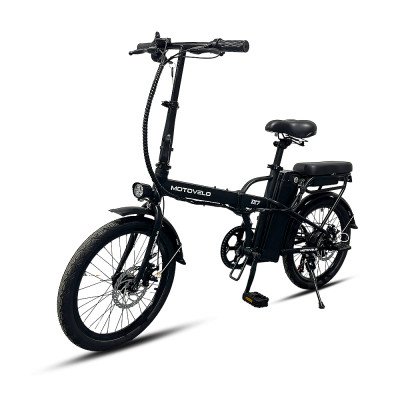
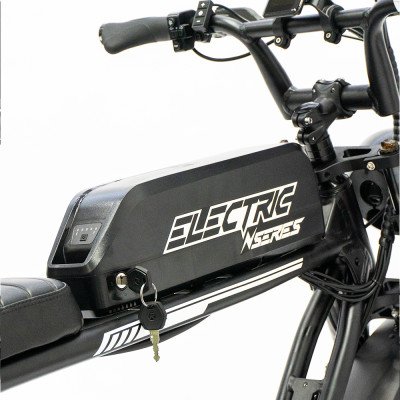
For food delivery in the city, the e-bike is often the fastest vehicle: no traffic jams, no parking, low running costs and no noise. A delivery e-bike needs a powerful motor, a battery with the range for a whole shift, a sturdy frame for delivery boxes and tyres that cope with cobblestones and poor roads.
Models
E-fatbikes with wide tyres – stable, comfortable, also for uneven roads and winter use.
Folding e-bikes – space-saving, can be stowed in the shop, car or storeroom.
Motors of around 250 to 500 W, 36 V or 48 V batteries for long range.
Rear racks for insulated boxes, lighting and disc brakes.
What businesses look for
Check the range at full load, the charging time (swappable battery for shift work), the payload for rider plus delivery box and the road approval: pedelecs up to 25 km/h and 250 W assistance require no licence in the EU; more powerful motors or higher speeds count as mopeds and need registration and insurance. Observe the regulations in your country.
Checklist
Range per charge and battery swap
Payload, rear rack, insulated box
Folding or fatbike
Registration and insurance for business use
More smart catering solutions: service robots and vending machines. For the delivery kitchen, pizza ovens and hot holding equipment are a good fit. iGastroNomic delivers at trade prices throughout Europe and advises you personally by phone and WhatsApp.
Frequently asked questions
How far does a delivery e-bike go on one charge?
Depending on battery, load, terrain and riding style, about 40 to 80 km. For shift work, a swappable battery or charging during breaks is recommended.
Do I need a driving licence for the e-bike?
Pedelecs up to 25 km/h with 250 W assistance require no licence in the EU. Faster or more powerful models count as mopeds and must be registered and insured.
Fatbike or folding e-bike?
The fatbike is more stable and comfortable on poor roads and in winter. The folding bike saves space and can be taken in the car.
How do I transport food on the e-bike?
With an insulated box on the rear rack or as a backpack. Pay attention to the rack's maximum load.
E-Bikes for Catering and Delivery Services
E-bikes for the catering industry are electrically assisted delivery bikes for restaurants, delivery services, caterers and hotels that deliver food quickly, cost-effectively and with zero emissions. They are ideal for anyone who wants to avoid vehicle costs and searching for parking in the city. When buying, the most important factors are motor power, battery capacity, range, frame stability and the right design.
E-bikes for Delivery Services and Restaurants: Areas of Use
An e-bike for delivery services often replaces a car or scooter in densely built inner cities. It can pass through pedestrian zones and traffic jams, requires no parking space and usually reaches customers within a few kilometres faster than a car. Typical applications include pizza delivery, burger and sushi delivery, catering, bakery and butcher deliveries, and distribution from central kitchens or staff canteens.
E-bikes for the catering industry are also worthwhile beyond classic food delivery. Hotels and resorts use them for trips across extensive grounds. Beach bars, beer gardens and event venues use them to transport drinks and food between locations. Staff also arrive at the workplace more relaxed and without sweating.
E-fatbike or Folding E-bike: Which Design Fits?
The e-fatbike has particularly wide tyres, a robust frame and a powerful motor. It remains stable on cobblestones, gravel, sand, wet leaves or snow and is suitable for off-road routes, uneven yard access and heavy deliveries. The folding e-bike, on the other hand, is compact and can be stored in a car boot, in a storeroom or in an office. It suits short inner-city routes and businesses with limited space.
The choice depends on your delivery profile. If you do long daily rounds with heavy loads, a robust e-fatbike is the better choice. If you need a flexible second vehicle for short distances, a folding e-bike with gears is often the better option.
Design
Typical Use
Special Feature
E-fatbike with 500 W and 48 V battery
Delivery on uneven paths, off-road, yard and terrain trips
Wide tyres, robust frame, powerful drive
E-fatbike with 500 W and 20 Ah battery
Long shifts, city deliveries with many stops
Large battery capacity for more range per charge
Folding e-bike with 36 V and 350 W
Short inner-city routes, hotels, transport in a vehicle
Compact folding design, 7 gears, 30–40 km range
Choosing the Right Motor Power, Battery and Range
The motor power determines how well the e-bike handles payload, gradients and headwinds. A 500 W drive offers significantly more reserves on loaded routes than a 350 W model. The battery voltage (e.g. 36 V or 48 V) and the capacity in ampere-hours (e.g. 20 Ah) together determine the range. The higher both values, the more kilometres the bike covers per charge.
Plan your average daily distance with a buffer, as payload, temperature, terrain and riding style reduce the range. For multi-shift operations, you should plan for a spare battery or fixed charging times in the work schedule. The manufacturer's figure of 30–40 km for a folding e-bike is a guideline that may differ in daily use depending on the load.
Durability, Materials and Safety in Daily Delivery Work
In delivery operations, e-bikes are exposed daily to rain, dirt, kerbs and heavy use. Therefore, pay attention to a stable frame, durable wheels, reliable brakes and good lighting. Gears and suspension improve riding comfort, especially with many stops and changing ground surfaces.
Luggage racks and delivery boxes are important for transporting food. They should be securely attached and must not affect handling. Before using the bike on public roads, check the registration, insurance and helmet regulations applicable in your country and to your power class.
Cost Efficiency: Reducing Operating Costs in Delivery Services
An e-bike causes significantly lower running costs than a delivery van or scooter. It uses only little electricity, requires no fuel and needs manageable maintenance. Parking fees and time lost searching for a parking space also disappear. For businesses that complement their catering supplies with sustainable delivery solutions, the fleet can be electrified step by step.
There is also the image benefit: customers appreciate emission-free delivery, and a visibly eco-friendly business stands out from the competition. The e-bike is thus both a means of transport and a marketing tool.
Care and Maintenance of Delivery Bikes
To keep your e-bike running reliably for a long time, clean it regularly and check the most important components. Check tyre pressure, brake pads, chain and lighting weekly if possible. Clean the bike with a damp cloth, not a high-pressure cleaner, so that no water gets into the motor, battery and electronics.
Store the battery dry and keep it away from heat and frost
Observe charging cycles and avoid deep discharge
Oil the chain regularly and tighten screws and brakes
Schedule maintenance at fixed intervals in your operations
Delivery Throughout Germany, Austria, Switzerland and Europe
iGastroNomic delivers e-bikes for catering and delivery services quickly and reliably throughout Germany, Austria, Switzerland and Europe. Restaurants, hotels, caterers, bakeries, butchers and staff canteens thus receive their delivery bike directly at their business. If you want to bundle your catering equipment in one place, you will find the right equipment for kitchen, counter and service alongside our e-bikes. If you have questions about power, battery or design, we are happy to advise you so you can find the right catering delivery vehicle for your business.

 Deutsch
 Türkçe
 Italiano
 Nederlands
 Français
 Español
 Polski
 Čeština
 Svenska
 Português PT
 Русский
 اللغة العربية
 中文
 日本語
 Tiếng Việt
 ภาษาไทย
 Română
 ελληνικά
 Magyar
 Dansk
 Suomi
 Hrvatski
 български език
 Eesti keel
 Latviešu valoda
 Slovenčina
 Slovenščina
 Bosanski
 עברית
 हिन्दी
 Bahasa melayu
 Kiswahili
 Bahasa Indonesia
 Papiamento
 Bokmål
 Lietuvių kalba
 Українська
 српски
 Shqip









 ›
 ›
 ›
 ›
 ›
 ›
 ›
 ›
 ›
 ›
 ›
 ›
 ›
 ›
 ›