When you visit any website, it may store or retrieve information on your
browser, mostly in the form of 'cookies'. This information, which might be about you, your preferences,
or your internet device (computer, tablet or mobile), is mostly used to make the site work as you expect
it to.
More info
Preferences
Statistics
Marketing
Hide detailsShow details
Preferences
Preference cookies enable a website to remember information that
changes the way the website behaves or looks, like your preferred language or the region that you are in.
Name
Provider
What it does
Expiry
Allow
(Check all)
Currency Selection
PrestaShop
Cookie which makes possible to choose the currency you would like. If disabled the store default currency will be shown.Cookie which makes possible to choose the currency you would like. If disabled the store default currency will be shown.
30 days
Language Selector
PrestaShop
Cookie we use to offer you the possibility to switch the language of our contents. If cookie is disabled you'll see the site in the original language.Cookie we use to offer you the possibility to switch the language of our contents. If cookie is disabled you'll see the site in the original language.
30 days
Statistics
Statistic cookies help website owners to understand how visitors interact
with websites by collecting and reporting information anonymously.
Name
Provider
What it does
Expiry
Allow
(Check all)
Marketing
Marketing cookies are used to track visitors across websites.
The intention is to display ads that are relevant and engaging for the individual user and thereby more
valuable for publishers and third party advertisers.
Name
Provider
What it does
Expiry
Allow
(Check all)
ad_storage
Google
Enables storage, such as cookies (web) or device identifiers (apps), related to advertising.Enables storage, such as cookies (web) or device identifiers (apps), related to advertising.
30 days
ad_user_data
Google
Sets consent for sending user data to Google for advertising purposes.Sets consent for sending user data to Google for advertising purposes.
30 days
ad_personalization
Google
Sets consent for personalized advertising.Sets consent for personalized advertising.
30 days
analytics_storage
Google
Enables storage, such as cookies (web) or app identifiers (apps), related to analytics, e.g. visit duration.Enables storage, such as cookies (web) or app identifiers (apps), related to analytics, e.g. visit duration.
Key facts: W × D × H 1510 × 800 × 1365 mm · 230 V · 50 Hz · 0.19 kW · approx. 428 l gross · +2/+8 °C · 2 glass doors · 20 shelf runners
Glass doors: products remain visible without unnecessarily interrupting the cold chain
GN space: interior for GN containers up to 150 mm deep
Flexible arrangement: 20 shelf runners at 55 mm spacing
Fan and defrosting: even cooling and automatic defrosting during operation
Bakery Refrigerators, Freezers and Counters in Euronorm Bakery Format
Bakeries, patisseries, pizzerias and hotel kitchens work with 600 × 400 mm bakery trays (EN standard) – not GN containers. Bakery refrigerators therefore have tray runners in exactly this format: dough pieces, croissants, cakes, pralines, pizza dough and cream desserts sit securely on the trays without being moved. Fan-assisted cooling keeps the temperature even, even when the door is opened frequently.
Appliance types
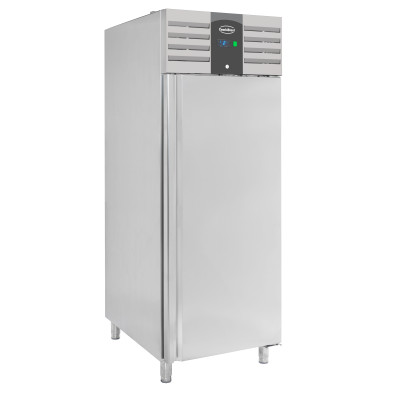
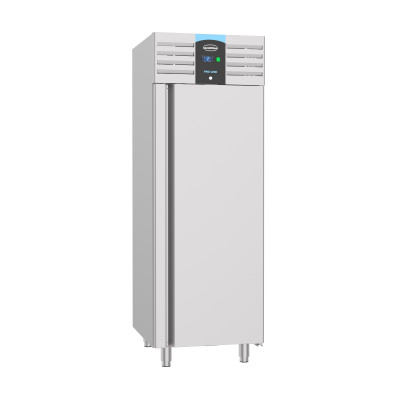
Bakery refrigerators with solid or glass door for around +2 to +8 °C, with 20 to 40 pairs of tray runners.
Bakery freezers for around -18 to -22 °C for storing dough pieces and frozen bakery products.
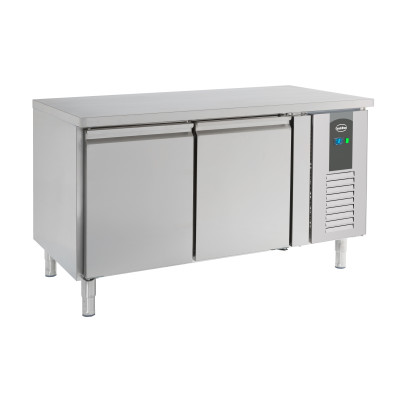
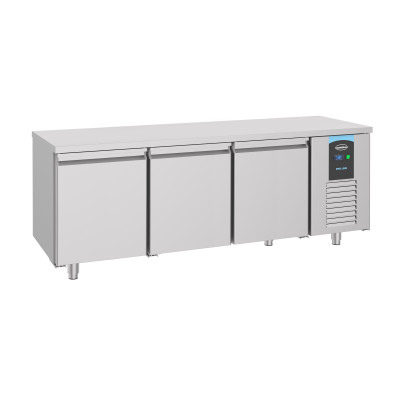
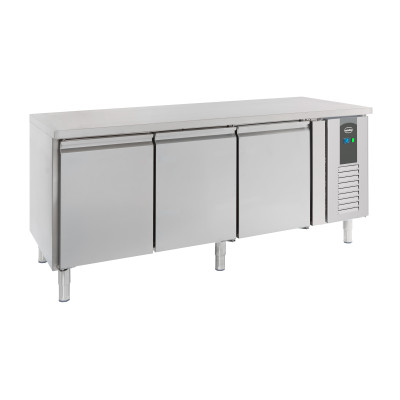
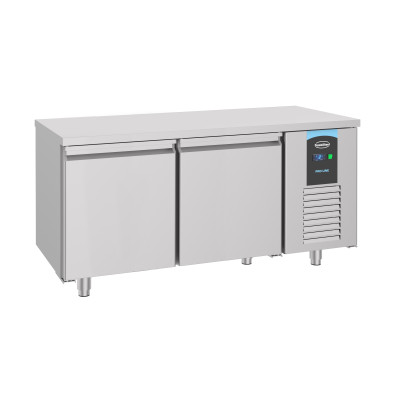
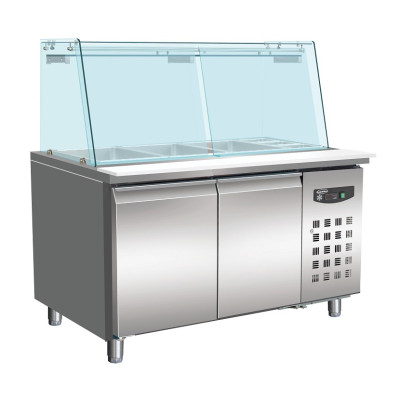
Bakery refrigerated counters with 2 or 3 doors and stainless steel or granite top – work surface and tray storage in one.
Monoblock units with plug-in refrigeration.
What professionals look for
Key are the tray spacing (how tall the products may be), the number of runners, strong fan circulation with automatic defrost, a digital temperature display, natural refrigerants such as R290 and stainless steel inside and out. For yeast dough pieces needing controlled proving there are also proving cabinets. The units usually run on 230 V.
Hygiene
Removable runners, rounded interior corners and replaceable gaskets make cleaning to HACCP easier. Always store cream and custards covered.
What is the difference between a bakery refrigerator and a catering refrigerator?
Bakery refrigerators have runners for 600 × 400 mm trays (bakery standard). Catering refrigerators are designed for Gastronorm containers and grids (GN 2/1 or 1/1).
How many trays fit in a bakery refrigerator?
Depending on height and runner spacing, 20 to 40 pairs of runners. The exact number and spacing are shown on each product.
Is a bakery refrigerator suitable for pizza dough?
Yes, dough balls in 600 × 400 mm dough boxes can be cold-fermented and stored ideally. That is why many pizzerias use bakery refrigerators or counters.
What connection does the unit need?
Bakery refrigerators and freezers usually run from a standard 230 V socket.
Bakery Refrigerators & Freezers for Sale
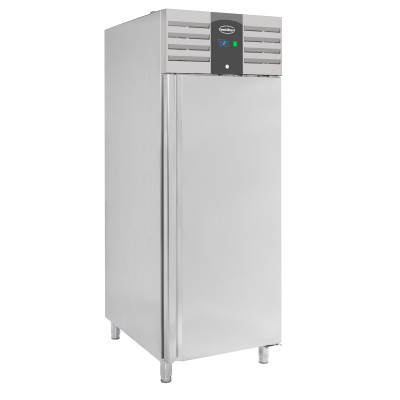
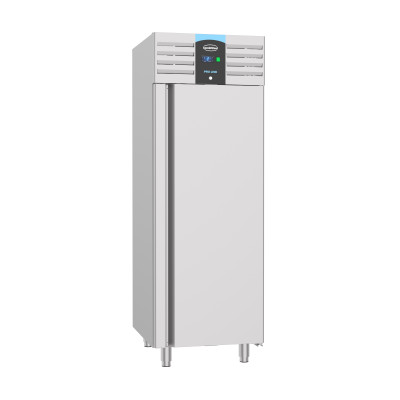
A bakery refrigerator or bakery freezer is a refrigeration unit for trays measuring 60x40 cm (Euronorm), in which bakeries, patisseries and baking stations store dough pieces, creams and baked goods. The units are built for continuous commercial operation. When buying, the key factors are capacity, tray capacity, temperature range (chilled or frozen) and design.
Bakery Refrigerators and Freezers: Applications
A bakery refrigerator belongs in every bakery that works with dough proofing, cream and custard products or prepared baked goods. Typical applications include artisan bakeries, patisseries, branch operations, hotel kitchens with their own pastry section, canteens and commercial kitchens. The bakery freezer holds dough pieces, unbaked products and ready-made items that you bake off later.
Those who separate daily production from baking times avoid peak workloads early in the morning. Refrigeration and freezer units in the 60x40 tray format allow you to store product directly from the baking tray or proofing rack without repacking. This keeps the cold chain unbroken and handling simple.
Size and Capacity: 700, 800 or 1400 Liters?
The right capacity depends on production volume and storage cycle. The range runs from units with 700 liters for smaller bakeries and branches, through models with 800 liters, to large-capacity units with 1400 liters for businesses with high daily output. It is better to allow some reserve, as air circulation between the trays is important for even temperatures.
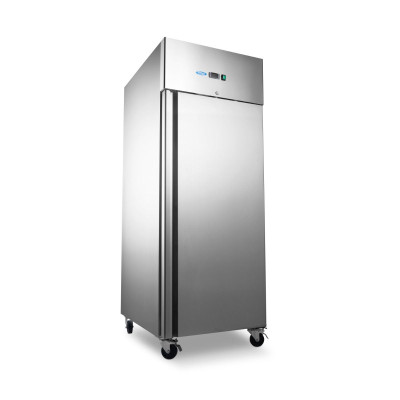
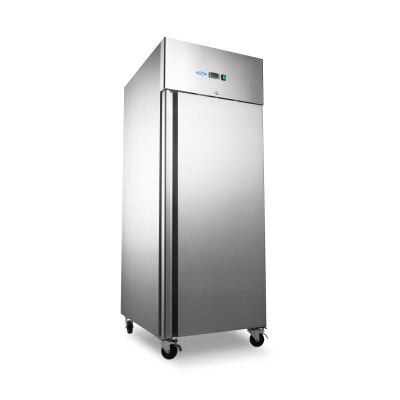
Also check floor space, door widths and ceiling height. A bakery refrigerator with castors can be moved more easily for cleaning or during refits. The model with double capacity and adjustable shelves adapts to different tray and container sizes.
Design Types Compared
The overview below shows which design suits which business. The freezer counter or refrigerated counter combines storage and work surface, whereas the cabinet offers more storage per square metre.
Variant
Typical Use
Feature
Bakery refrigerator, 700 liters
Small to medium bakery, branch
Holds 60x40 cm trays, chilled zone
Bakery freezer, 700 liters
Storage of dough pieces and ready-made goods
Freezer zone, standard and Plus equipment
Bakery refrigerator, 1400 liters
Large bakery, high daily output
Double the volume of the 700-liter variant
Bakery freezer, 1400 liters
Large operations, central production
Large stock of frozen goods
Gastro bakery refrigerator or freezer cabinet, 800 liters
Flexible bakery with changing containers
Adjustable shelves, on castors, suitable for 60x40 cm
Bakery refrigerated counter with 2 or 3 doors / freezer monoblock
Workstation and storage in one unit
Work surface or integrated refrigeration unit (monoblock)
Chilled or Frozen: Technology and Selection
A bakery refrigerator operates in the positive temperature range and is suitable for dough in retarding, creams, dairy products and filled baked goods. The freezer keeps goods below zero and allows long storage periods. The monoblock version has the refrigeration unit already integrated, so no separate cooling set is needed and commissioning remains simple.
Look for energy-efficient units with good insulation and tight doors, as refrigeration units run around the clock every day. The Premium and Premium Plus variants differ in equipment level. This helps you choose the model that suits your budget and application.
Material and Hygiene
Commercial bakery refrigeration units are usually made of stainless steel. The material is robust, food-safe and easy to clean. Smooth interior surfaces without edges make HACCP hygiene requirements easier to meet, and sturdy tray runners hold loaded trays securely. High-quality commercial refrigeration units are designed for frequent door opening in everyday bakery operations.
If you put together your catering equipment range deliberately, combine refrigeration with matching baking trays, transport trolleys and work tables in the same format. This keeps paths short and workflows clean.
Care and Maintenance
Clean the interior and seals regularly with a mild detergent and dry them afterwards. Keep the condenser free from dust and flour deposits, as flour dust settles quickly in bakeries and reduces cooling performance. Plan regular defrost cycles and check the temperature. Annual servicing by a refrigeration specialist considerably extends service life.
Delivery in Germany, Austria, Switzerland and Europe
iGastroNomic delivers your catering supplies quickly and reliably by freight forwarder throughout Germany, to Austria, to Switzerland and to other European countries. Especially for large-capacity units with 1400 liters, safe delivery is important. We are happy to advise you on size and design so that your bakery refrigeration fits your business perfectly.

 Deutsch
 Türkçe
 Italiano
 Nederlands
 Français
 Español
 Polski
 Čeština
 Svenska
 Português PT
 Русский
 اللغة العربية
 中文
 日本語
 Tiếng Việt
 ภาษาไทย
 Română
 ελληνικά
 Magyar
 Dansk
 Suomi
 Hrvatski
 български език
 Eesti keel
 Latviešu valoda
 Slovenčina
 Slovenščina
 Bosanski
 עברית
 हिन्दी
 Bahasa melayu
 Kiswahili
 Bahasa Indonesia
 Papiamento
 Bokmål
 Lietuvių kalba
 Українська
 српски
 Shqip











 ›
 ›
 ›
 ›
 ›
 ›
 ›
 ›
 ›
 ›
 ›
 ›
 ›
 ›
 ›