When you visit any website, it may store or retrieve information on your
browser, mostly in the form of 'cookies'. This information, which might be about you, your preferences,
or your internet device (computer, tablet or mobile), is mostly used to make the site work as you expect
it to.
More info
Preferences
Statistics
Marketing
Hide detailsShow details
Preferences
Preference cookies enable a website to remember information that
changes the way the website behaves or looks, like your preferred language or the region that you are in.
Name
Provider
What it does
Expiry
Allow
(Check all)
Currency Selection
PrestaShop
Cookie which makes possible to choose the currency you would like. If disabled the store default currency will be shown.Cookie which makes possible to choose the currency you would like. If disabled the store default currency will be shown.
30 days
Language Selector
PrestaShop
Cookie we use to offer you the possibility to switch the language of our contents. If cookie is disabled you'll see the site in the original language.Cookie we use to offer you the possibility to switch the language of our contents. If cookie is disabled you'll see the site in the original language.
30 days
Statistics
Statistic cookies help website owners to understand how visitors interact
with websites by collecting and reporting information anonymously.
Name
Provider
What it does
Expiry
Allow
(Check all)
Marketing
Marketing cookies are used to track visitors across websites.
The intention is to display ads that are relevant and engaging for the individual user and thereby more
valuable for publishers and third party advertisers.
Name
Provider
What it does
Expiry
Allow
(Check all)
ad_storage
Google
Enables storage, such as cookies (web) or device identifiers (apps), related to advertising.Enables storage, such as cookies (web) or device identifiers (apps), related to advertising.
30 days
ad_user_data
Google
Sets consent for sending user data to Google for advertising purposes.Sets consent for sending user data to Google for advertising purposes.
30 days
ad_personalization
Google
Sets consent for personalized advertising.Sets consent for personalized advertising.
30 days
analytics_storage
Google
Enables storage, such as cookies (web) or app identifiers (apps), related to analytics, e.g. visit duration.Enables storage, such as cookies (web) or app identifiers (apps), related to analytics, e.g. visit duration.
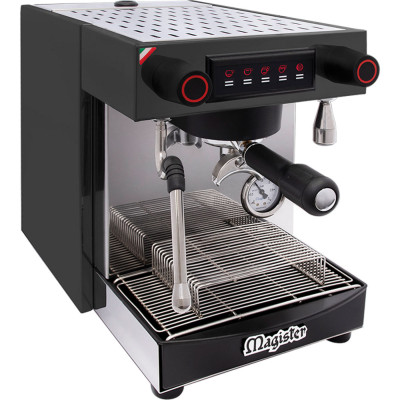
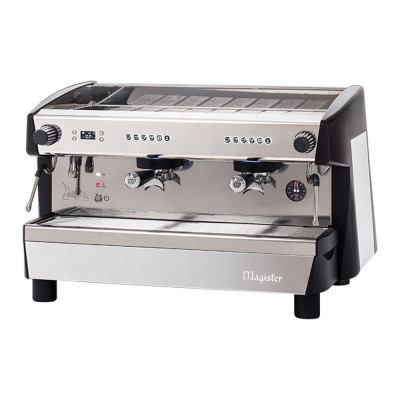
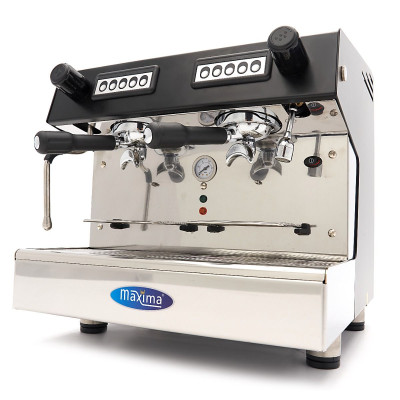
A traditional espresso machine with portafilter is the heart of every coffee bar. Ground coffee is tamped in the portafilter and extracted under pressure with hot water; the steam wand froths milk for cappuccino and latte. A commercial espresso machine differs from a domestic one through large boilers, stable brewing temperature, several groups and continuous operation for hundreds of cups a day.
How many groups?
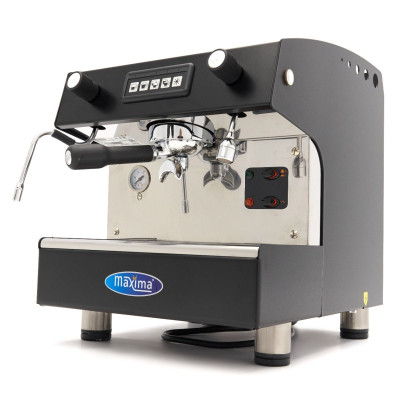
1 group – small cafés, restaurants, bakeries, offices; up to about 100 cups a day.
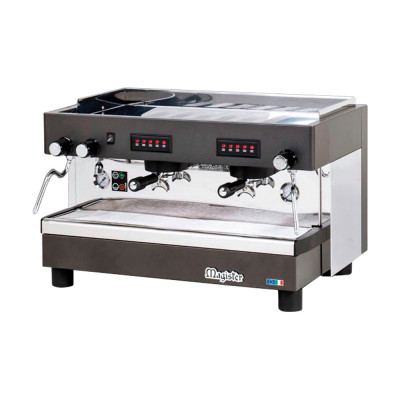
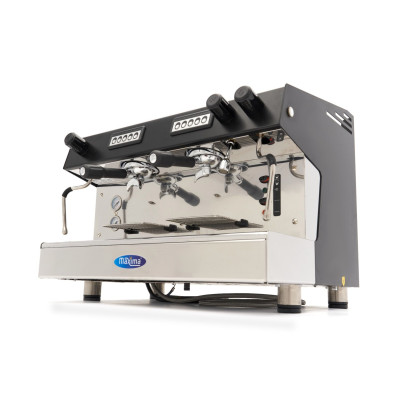
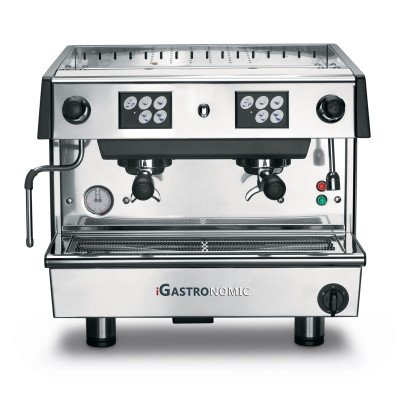
2 groups – the standard for coffee bars and cafés with peak times.
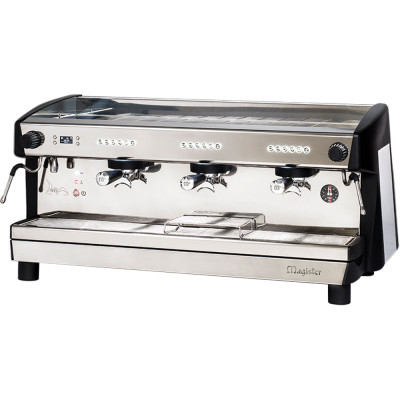
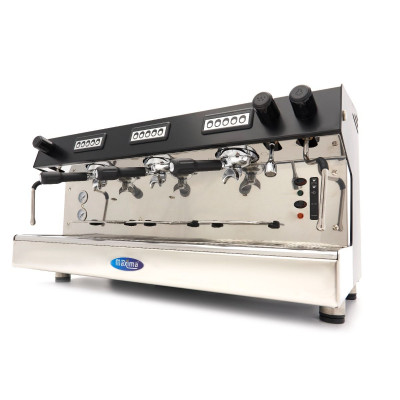
3 groups – coffee shops, hotels and bars with very high demand and several baristas.
Technology
Look for a sufficiently large boiler (steam power for milk), heat exchanger or dual boiler for stable brewing temperature, E61 or heated groups, pre-infusion, a rotary pump for plumbed water connection and programmable dosing. Large machines are permanently connected to water and drain and run on 230 V or 400 V depending on output. A water filter is essential against limescale.
Accessories
A matching coffee grinder is just as important as the machine. Add tampers, knock boxes, milk jugs, automatic milk frothers and cleaning products.
Care
Backflush the groups daily, clean baskets and steam wand, empty the drip tray; regularly replace gaskets and shower screens and descale or change the filter.
Checklist
Cups per day → number of groups
Boiler size and system
Plumbed or tank, 230/400 V
Grinder and accessories
For the complete café see hot water dispensers, blenders and drinks fridges. iGastroNomic delivers at trade prices throughout Europe and advises you personally by phone and WhatsApp.
Frequently asked questions
How many groups do I need?
Up to about 100 cups a day one group is enough. Cafés with peak times work with two groups, coffee shops and hotels with very high demand with three.
What is the difference between heat exchanger and dual boiler?
In a heat exchanger machine one boiler provides steam and heats the brew water via a heat exchanger. A dual boiler has separate boilers for brewing and steam – even more stable temperatures when brewing and steaming at the same time.
Do I need a water connection?
Machines with a rotary pump are permanently connected to water and drain. Small models with a vibration pump have a tank. A water filter is advisable in any case.
What power supply does an espresso machine need?
One-group and many two-group machines run on 230 V. High-output two- and three-group machines need 400 V. The information is on each product.
Commercial Espresso & Coffee Machines for Catering
Commercial espresso and coffee machines for catering are professional units that serve espresso, cappuccino and latte macchiato at consistent quality in cafés, restaurants, hotels and bakeries. They differ mainly in design (portafilter machine or piston machine), number of groups and output in cups per hour. When buying, the expected peak demand, the available space and the existing connections are therefore key factors.
Applications: Which coffee machine suits your business?
A commercial espresso machine runs continuously and must deliver coffee reliably even during peak times. In a café or bar, the machine is the centre of the business. In a restaurant or hotel, it ensures quick refills after meals or at the breakfast buffet. Bakeries, canteens and snack bars also rely on robust equipment that can prepare many cups in a short time.
Whether you are setting up your café or expanding your catering equipment, the machine should match your daily operation. If you only serve coffee occasionally, you need a different unit than a business with all-day coffee sales.
Buy a portafilter machine: 1, 2 or 3 groups
The classic portafilter machine brews espresso via a portafilter that the barista fills and locks in by hand. This gives you full control over grind size, dosing and tamping. The number of groups is decisive: a 1-group portafilter machine is suitable for small cafés, offices or secondary counters. With 2 groups, two shots can run at the same time, which is the standard in many cafés and restaurants. The 3-group portafilter machine is designed for businesses with high throughput.
Some portafilter machines feature touch operation. This allows shot volumes to be set repeatably via a button or display. It saves time and helps when several staff members work on the machine. Classic models with push buttons, on the other hand, are particularly easy to operate.
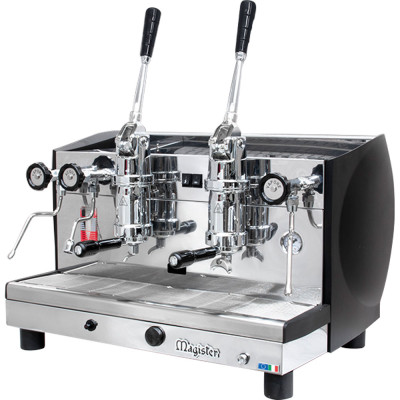
Piston espresso machine for high throughput
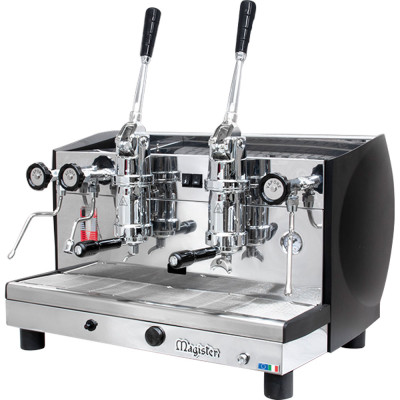
If you search online for a piston espresso machine, you usually mean a commercial espresso machine with several brew groups and portafilters. In our range you will find a 2-piston espresso machine in a compact design as well as in standard size, each rated at 360 cups per hour. For higher demand, there is the 3-piston espresso machine at 540 cups per hour. The compact design fits on small counter areas without compromising on performance.
Variant
Capacity / Groups
Typical use
Portafilter machine 1 group
1 shot at a time
Small café, office, secondary counter
Portafilter machine 2 groups
2 shots at a time
Café, restaurant, hotel
Portafilter machine 3 groups
3 shots at a time
Businesses with high throughput
Espresso machine 2 pistons, compact or standard
360 cups per hour
Café, bakery, snack bar
Espresso machine 3 pistons
540 cups per hour
Large business, canteen, hotel breakfast
Buying advice: Size, capacity and connections
Plan the capacity according to your peak demand, not the average. A machine with some reserve works more calmly and delivers consistent quality even during rush hour. Also check the footprint on the counter and the height under shelves, as the portafilter needs room to be inserted and removed.
The connections are important: commercial machines require a water supply, drainage and often a powerful electrical connection. Before buying, clarify whether a standard socket is sufficient or whether a three-phase power connection is required. A water filter protects the boiler from limescale and improves the taste.
Coffee grinder, hopper and accessories
A good machine needs a suitable coffee grinder. When choosing one, look for a sturdy hopper for the coffee grinder that holds enough beans and can be cleaned easily. It determines how often you need to refill and how cleanly the beans travel from the hopper to the grinding mechanism. The quality of the grind has a direct effect on crema and taste.
Daily work at the coffee station also requires knock boxes for coffee grounds (for 1–2 groups or for larger machines) as well as large and small knock bars. This keeps the workspace clean and the grounds can be disposed of quickly. These accessories complete your catering supplies for the café.
Materials, care and maintenance
Commercial coffee machines are mostly made of stainless steel. The material is robust, easy to wipe clean and withstands daily use. Flush the brew groups after every service, clean screens and portafilters regularly and remove coffee residue from the gasket. The steam wand should be wiped down and briefly purged after each milk frothing.
Also plan for regular descaling and replacement of the water filters. This extends the service life of the machine and keeps the espresso consistently good. Those who consistently care for both machine and grinder avoid breakdowns during operation.
Delivery throughout Germany, Austria, Switzerland and Europe
iGastroNomic delivers espresso and coffee machines quickly and reliably throughout Germany, Austria, Switzerland and Europe. This applies to cafés, hotels, bakeries, canteens and commercial customers. You receive your machine together with its accessories directly at your business and can put it into operation without long waiting times.

 Deutsch
 Türkçe
 Italiano
 Nederlands
 Français
 Español
 Polski
 Čeština
 Svenska
 Português PT
 Русский
 اللغة العربية
 中文
 日本語
 Tiếng Việt
 ภาษาไทย
 Română
 ελληνικά
 Magyar
 Dansk
 Suomi
 Hrvatski
 български език
 Eesti keel
 Latviešu valoda
 Slovenčina
 Slovenščina
 Bosanski
 עברית
 हिन्दी
 Bahasa melayu
 Kiswahili
 Bahasa Indonesia
 Papiamento
 Bokmål
 Lietuvių kalba
 Українська
 српски
 Shqip














 ›
 ›
 ›
 ›
 ›
 ›
 ›
 ›
 ›
 ›
 ›
 ›
 ›
 ›
 ›