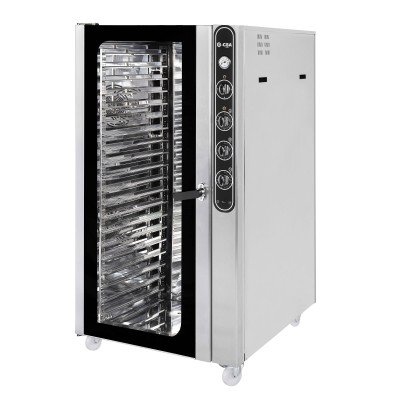
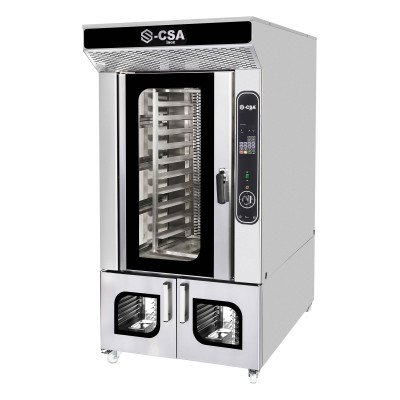
Combi ovens and convection ovens are essential appliances for kitchens and bakehouses that must deliver consistent results in continuous operation. Whether you use a commercial combi oven to bake dough, cook or regenerate dishes, uniformity, reliability and a suitable connection to your workflows are what matter. At iGastroNomic you will find combi ovens and convection ovens for bakeries for restaurants, snack bars, hotels, canteens, bakeries and caterers.
Applications in Foodservice and Bakery
Requirements vary by business. Typical applications include:
Bakery and patisserie: bread, rolls and fine pastries benefit from even heat distribution and good crust formation.
Café and breakfast service: reheating croissants, snacks and convenience products in a short time.
Caterers and central kitchens: cooking, regenerating and holding larger quantities in GN containers.
Snack bars and quick-service restaurants: repeatable results at high throughput.
Variants: Rotary Oven, Electric or Gas
The range includes rotating convection ovens with electric or gas heating, some with an integrated proofer. A rotary oven moves the baked goods during the baking process, ensuring even browning even with larger batches. Electric models are usually easier to connect to existing power supplies, while gas models require professional gas installation and adequate ventilation. Digital controls enable reproducible programs, while manual operation works well for consistent, simple routines.
What Professionals Look for When Buying
Heating type: electric or gas, depending on available connections and ventilation on site.
Controls: manual or digital, depending on staff expertise and the need for repeatable programs.
Loading: choose tray size and number of shelves to match your daily production.
Integrated proofer: saves floor space and steps and makes sense for daily fresh-dough production.
Installation: coordinate floor space, connection and ventilation with your installer before ordering.
Cleaning, Maintenance and Safe Operation
Regular cleaning extends service life and keeps baking results consistent. Clean the baking chamber and door seals after every use, remove grease deposits promptly and check ventilation paths. Gas appliances also require regular inspections by qualified specialists. The operating manual always defines the relevant intervals and cleaning agents.
Why Buy from iGastroNomic
iGastroNomic is a manufacturer and wholesaler of foodservice and commercial kitchen equipment based in Nackenheim. Trade customers receive B2B net prices and a wide selection of appliances. You can reach our personal advice team by phone or via WhatsApp, so that the appliance, connection and intended use can be agreed together. We deliver across Europe.
Frequently asked questions
What is the difference between a combi oven and a convection oven?
A combi oven typically combines hot air and steam, while a convection oven works exclusively with dry, circulated hot air. Convection ovens are especially common in bakeries because they bake bread and fine pastries evenly. The right choice depends mainly on which products you cook or bake most often.
Are electric or gas bakery ovens better for commercial use?
Both types are common in commercial use. Electric ovens are usually easier to connect, while gas ovens require professional gas installation and adequate ventilation. The best option depends on your existing connections and the conditions on site.
What does a rotary oven do in a bakery?
A rotary oven moves the baked goods during baking by rotating the baking chamber or the trays. This results in more even browning and proofing, even with larger quantities. It is particularly suitable for businesses with a high daily output of bread and baked goods.
Is an oven with an integrated proofer worthwhile?
An integrated proofer saves floor space and walking distances, because dough can be proofed and baked directly afterwards. This is especially useful for daily fresh-dough production in small or medium-sized bakeries. If you only process dough occasionally, a separate appliance is often sufficient.
Can I buy combi ovens and bakery ovens from iGastroNomic as a trade customer?
Yes, iGastroNomic supplies trade customers at B2B net prices from a wide selection. You can get personal advice by phone or via WhatsApp. Delivery is available across Europe.
Combi Ovens & Convection Ovens for Bakery and Catering
Combi ovens are commercial convection and baking ovens used in bakeries, restaurants, hotels and large kitchens to bake, cook and regenerate. When choosing, consider loading capacity (trays in 60x40 format or GN containers), energy type (electricity or gas), control (manual or digital) and an optional proving cabinet. At iGastroNomic you will find commercial combi ovens for small bakeries as well as for continuous professional operation.
Combi Ovens for Catering, Bakery and Large Kitchens
A combi oven replaces several individual appliances in many businesses. In the bakery, you bake bread, rolls and fine pastries. In the patisserie and café, puff pastry, croissants and cakes turn out perfectly. In hotels, canteens and catering, you cook, gratinate and regenerate food in large quantities. Recipes can be reproduced consistently, and the space required in the kitchen is reduced.
In catering equipment, the models differ mainly in their loading capacity. Models for 10 trays in EN 60x40 format are the standard for bakeries. Larger units for 20 shelves in 2/1 GN format are suitable for businesses with high throughput, such as large kitchens, canteens and caterers.
Rotating Convection Oven or Deck Oven?
With a rotating convection oven, the baking rack or shelf trolley rotates inside the baking chamber during baking. The hot air reaches every tray evenly, so you achieve even browning even at full load. This is important for rolls, baguettes and pastries where uniform appearance matters. An electric convection oven with shelves for 2/1 GN containers, on the other hand, is more flexible if you prepare food in gastronorm containers alongside baked goods.
Many rotating models have a proving cabinet in the base. Dough pieces rise there under controlled conditions and then move directly into the oven. This saves floor space, steps and time, especially in smaller bakeries and branch operations.
Variants at a Glance
Design
Typical use
Special feature
Rotating electric convection oven, manual, 10x EN 60x40, with proving cabinet
Bakery, café, patisserie
Simple operation, proving cabinet in base
Rotating electric convection oven, digital, 10x EN 60x40, with proving cabinet
Businesses with changing baking programmes
Digital control for consistent results
Electric convection oven, manual, 20x EN 2/1 GN
Large kitchen, canteen, catering
High capacity, 2/1 GN containers usable
Rotating gas convection oven, digital, 10x EN 60x40, with proving cabinet
Bakery with gas connection
Gas operation with digital control
Electric or Gas: Which Connection Suits You?
The energy type determines installation and operating costs. An electric combi oven requires a suitable three-phase power connection, which your electrician should check. It is straightforward to install and suits kitchens and bakeries without a gas line. A gas convection oven is worthwhile if a gas connection is already in place and you produce large baking volumes over long operating hours. For gas appliances, observe the flue gas routing and the requirements for installation room and ventilation.
Before buying, also plan the floor space, the door swing and the room needed to wheel in baking racks or trolleys. A bakery oven must also keep sufficient distance from walls and other equipment so that heat can dissipate.
Manual or Digital Control
A manual control with rotary knobs for temperature and time is robust and quick to learn. It suits businesses with a consistent product range. A digital control stores baking programmes and makes work easier when staff change. Every batch is baked the same way, operating errors become rarer, and waste decreases. If several employees work with the oven, the digital version is usually the more economical choice.
Materials, Hygiene and Care
Stainless steel housings and a stainless steel baking chamber are the standard for continuous use. The material is heat-resistant, corrosion-resistant and can be cleaned hygienically. After cooling, clean the baking chamber regularly with suitable agents, remove dough residue and grease, and check the door seal. Keep the proving cabinet and rotation mechanism clean as well. This maintains performance and extends the service life of the commercial baking oven. Annual maintenance by a specialist company ensures reliable operation.
Delivery to Germany, Austria, Switzerland and Europe
iGastroNomic delivers your new oven quickly and reliably throughout Germany, to Austria, Switzerland and other countries in Europe. Large appliances are delivered by freight carrier to ensure they arrive safely. If you want to source your catering supplies from one place, you will find suitable accessories for kitchen, bakery and serving alongside our ovens.

 Deutsch
 Türkçe
 Italiano
 Nederlands
 Français
 Español
 Polski
 Čeština
 Svenska
 Português PT
 Русский
 اللغة العربية
 中文
 日本語
 Tiếng Việt
 ภาษาไทย
 Română
 ελληνικά
 Magyar
 Dansk
 Suomi
 Hrvatski
 български език
 Eesti keel
 Latviešu valoda
 Slovenčina
 Slovenščina
 Bosanski
 עברית
 हिन्दी
 Bahasa melayu
 Kiswahili
 Bahasa Indonesia
 Papiamento
 Bokmål
 Lietuvių kalba
 Українська
 српски
 Shqip









 ›
 ›
 ›
 ›
 ›
 ›
 ›
 ›
 ›
 ›
 ›
 ›
 ›
 ›
 ›