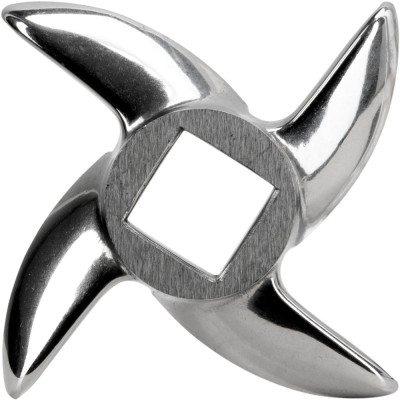
A meat mincer (meat grinder) cuts meat into mince of the required coarseness using a feed screw, cross knife and hole plate. Mincing your own meat lets you control quality, fat content and freshness – and saves money. A professional mincer differs from a domestic one through a powerful geared motor, a mincing head of stainless steel or tinned cast iron and outputs of 80 to 500 kg per hour.
Sizes and output
Size 12 – entry level for restaurants and takeaways, about 80–150 kg/h, often on 230 V.
Size 22 – butcher's standard with about 200–300 kg/h, usually 400 V.
Size 32 – for butcheries and production with 400 kg/h and more, 400 V.
The size refers to the hole plate diameter; plates and knives are interchangeable within a size.
Features
Look for a reverse function for blockages, a stainless steel head (hygienic, rust-free), a large feed tray with pusher, a safety switch and quiet gearing. Hole plates with different bores (e.g. 3, 4.5, 6, 8 mm) determine the coarseness. Models with a refrigerated mincing head keep the meat cold. Combination units with a vegetable cutter attachment save space.
Hygiene and care
Dismantle, wash and dry the head, screw, knife and plates after every use; lightly oil cast iron parts. Process meat well chilled, ideally straight from the refrigerator.
Checklist
kg per hour and size (12/22/32)
230 V or 400 V
Stainless steel head, reverse function
Plates and knives supplied
For further processing see sausage fillers, meat mixers and burger presses. iGastroNomic delivers at trade prices throughout Europe and advises you personally by phone and WhatsApp.
Frequently asked questions
Which mincer size do I need?
For restaurants and takeaways size 12 with 80–150 kg/h is usually enough. Butchers and production kitchens work with size 22 or 32 and 200 to 500 kg/h.
What do size 12, 22 or 32 mean?
The number refers to the mincer system or hole plate diameter. Plates and knives of the same size fit different machines.
Do I need 400 V for a meat mincer?
Small size 12 mincers often run on 230 V. Sizes 22 and 32 with high output usually need 400 V.
Can I fill sausages with the mincer?
With a filling funnel attachment, small quantities can be filled. For regular sausage production a separate sausage filler is the better choice.
Catering Meat Grinder: Electric Professional Meat Mincers
Meat grinders are electric kitchen appliances that mince meat, fish or vegetables to an even consistency and are used for minced meat, sausage meat and forcemeat. A catering meat grinder is aimed at restaurants, butcher shops, hotels and large kitchens. When buying, the key factors are the throughput in kg/h, the motor power in kW, the power connection (230 V or 380 V) and whether you need a meat grinder with cooling.
Catering meat grinder: applications in professional operations
A catering meat grinder belongs in butcher shops, restaurants with their own minced meat production, hotels, canteens and snack bars that prepare burger patties, meatballs, meatloaf or bratwurst mixture fresh. Anyone who grinds their own meat decides the fat content, grain size and freshness and does not need ready-made goods. Fish, vegetables and cheese can also be processed. The range is a fixed part of professional catering equipment.
The models in this category are electric meat grinders for continuous use. They range from compact units for small kitchens to high-performance machines for sausage production in the butcher's shop.
Buying advice: what output does a catering meat grinder need?
The most important selection criterion is the throughput in kg/h. For smaller kitchens with occasional demand, a unit with 125 kg/h and 0.55 kW is sufficient. For daily use in restaurants, snack bars or small butcher shops, 400 kg/h at 1.5 kW is a good choice. Anyone processing larger quantities should choose 600 kg/h at 2.2 kW or the version with 800 kg/h.
Plan your capacity with a reserve. A motor that does not constantly run at its limit works more evenly and lasts longer. Also check how much space is available on the work surface and whether you need to move the unit frequently.
Variant
Typical use
Special feature
125 kg/h, 0.55 kW
Small kitchen, snack bar, occasional minced meat preparation
Compact design, low motor power
400 kg/h, 1.5 kW
Restaurant, hotel kitchen, small butcher shop
Common performance class for daily operation
600 kg/h, 2.2 kW
Large kitchen, butcher shop, canteen
High throughput for large quantities
800 kg/h, 1.5 kW
Butcher shop, meat processing with high demand
Highest throughput in this category
400–600 kg/h with cooling
Hygienically sensitive meat processing
Cooling for consistently cool grinding material
Meat grinder with cooling: benefits for freshness and hygiene
A meat grinder with cooling keeps the material cool during processing. This matters because meat warms up during grinding due to friction and heat. Cooling supports compliance with the cold chain and helps achieve a clean, non-smeared grain. Especially for minced meat and sausage mixture, which are hygiene-sensitive, this is a clear advantage.
This category includes cooled meat grinders with 400 kg/h and 1.5 kW as well as with 600 kg/h and 2.2 kW. A model with 3 kW covers even higher requirements. Butcher shops and businesses with high hygiene standards prefer these units.
Power connection: choosing 230 V or 380 V correctly
Check before buying which power connection is available in your kitchen. Several models are available with 230 V single-phase AC and can run from a standard socket. More powerful units are also available with 380 V three-phase, which many butcher shops and large kitchens already provide. Three-phase units often run more powerfully but need a suitable connection. If in doubt, please check with your qualified electrician.
Material and hygiene in professional meat grinders
Professional meat grinders are made of stainless steel, as the material is robust, food-safe and easy to clean. Important are smooth surfaces that can be thoroughly cleaned, and a removable grinding unit with auger, cutting plate and knife. These parts come into direct contact with the meat. They should therefore be removable without tools or with just a few simple steps. In businesses with a HACCP concept, this is a must.
Care and maintenance for a long service life
Clean the grinding unit thoroughly after every use: disassemble, remove meat residues, rinse parts and dry them completely. Cut meat into suitable pieces before grinding, remove bones and tough sinews, and keep knives and cutting plate sharp. Blunt parts heat the meat unnecessarily and strain the motor. Replace wear parts in good time. A catering meat tenderizer for flattening schnitzel is a separate kitchen appliance and does not replace the meat grinder.
Delivery across Germany, Austria, Switzerland and Europe
We deliver your meat grinder quickly and reliably across all of Germany, Austria, Switzerland and Europe. This way, caterers, butchers, hoteliers and canteen operators receive their catering equipment without long waiting times. All units are designed for commercial use. Choose the right capacity class for your business and order conveniently online from iGastroNomic.

 Deutsch
 Türkçe
 Italiano
 Nederlands
 Français
 Español
 Polski
 Čeština
 Svenska
 Português PT
 Русский
 اللغة العربية
 中文
 日本語
 Tiếng Việt
 ภาษาไทย
 Română
 ελληνικά
 Magyar
 Dansk
 Suomi
 Hrvatski
 български език
 Eesti keel
 Latviešu valoda
 Slovenčina
 Slovenščina
 Bosanski
 עברית
 हिन्दी
 Bahasa melayu
 Kiswahili
 Bahasa Indonesia
 Papiamento
 Bokmål
 Lietuvių kalba
 Українська
 српски
 Shqip









 ›
 ›
 ›
 ›
 ›
 ›
 ›
 ›
 ›
 ›
 ›
 ›
 ›
 ›
 ›