Deutsch
 Türkçe
 Italiano
 Nederlands
 Français
 Español
 Polski
 Čeština
 Svenska
 Português PT
 Русский
 اللغة العربية
 中文
 日本語
 Tiếng Việt
 ภาษาไทย
 Română
 ελληνικά
 Magyar
 Dansk
 Suomi
 Hrvatski
 български език
 Eesti keel
 Latviešu valoda
 Slovenčina
 Slovenščina
 Bosanski
 עברית
 हिन्दी
 Bahasa melayu
 Kiswahili
 Bahasa Indonesia
 Papiamento
 Bokmål
 Lietuvių kalba
 Українська
 српски
 Shqip


 ›
 ›
 ›
 ›
 ›
 ›
 ›
 ›
 ›
 ›
 ›
 ›
 ›
 ›
 ›
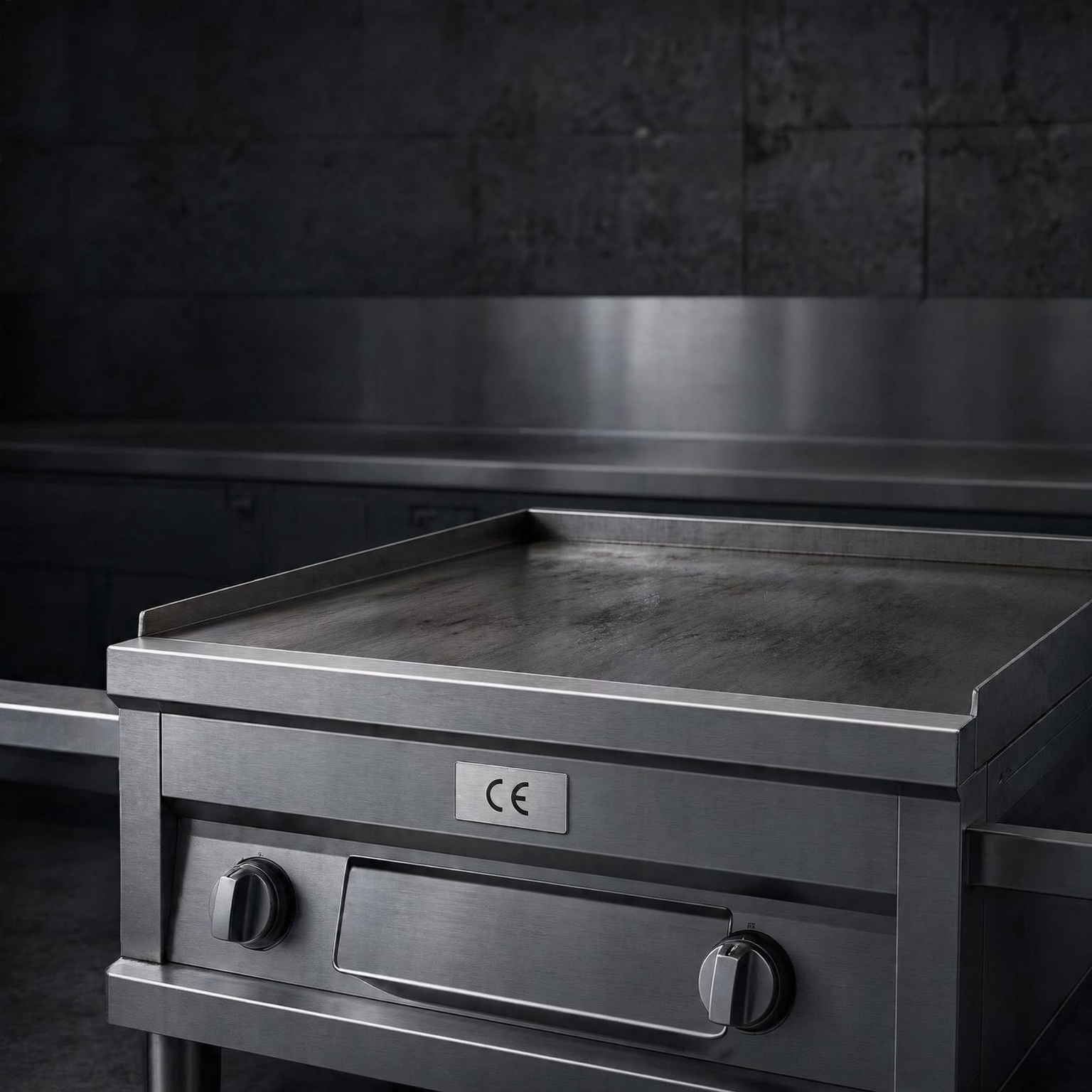
In short: A fry top with CE certification carries the CE mark, with which the manufacturer declares that the griddle plate meets the applicable EU requirements for safety, health and environmental protection. The CE mark is not a quality label, but it is a prerequisite for placing a fry top on the market in the EU. For gas appliances, a notified body is usually also involved in the assessment.
What is a fry top?
A fry top is a large, flat griddle plate for frying, grilling and keeping food warm. In commercial kitchens it is used as a standalone unit or as part of a combination range, and occasionally in private households as well.
Material and surface
The plate is usually made of cast iron or steel. The surface is smooth or slightly ribbed, so that different cooking methods can be carried out depending on the food. Fry tops are considered robust and offer even heat distribution.
Typical applications
On a fry top, meat, fish, vegetables, egg dishes or pancakes are prepared. The appliance is standard equipment especially in snack bars, bistros, burger kitchens and restaurants.
What does CE certification mean?
The CE marking stands for Conformité Européenne ("European conformity"). It indicates that a product meets the EU legal requirements applicable to its product type. Without the CE mark, many products, including commercial kitchen equipment, may not be newly sold in the EU.
What the CE mark is
The CE mark is a conformity marking. With it, the manufacturer confirms that its product meets the basic requirements for safety, health protection and environmental protection. For a fry top, this includes, for example, electrical safety, protection against overheating, fire safety and, for gas appliances, safe combustion.
What the CE mark is not
The CE mark is not a classic quality label and not automatically an independent test seal. It says nothing about how durable, energy-efficient or well built an appliance is. It does, however, show that the legal minimum requirements have been documented and met.
Why is CE certification important for fry tops?
In commercial kitchens, appliances run every day for many hours at high temperatures. A fry top without verifiable conformity can pose safety risks, for example through overheating, faulty electrics or leaking gas connections.
- Safety: The appliance has been assessed for electrical and mechanical safety and, in the case of gas, for combustion safety.
- Health protection: The requirements are intended to ensure that the appliance and its surfaces do not pose unacceptable health hazards.
- Legal requirements: Placing non-compliant appliances on the market can be prohibited in the EU and may lead to penalties.
- Consumer and guest protection: Operators and staff can rely on a documented minimum standard.
- Liability and insurance: In the event of damage, a missing CE mark can lead to disputes with authorities, insurers or manufacturers.
Which EU requirements apply to fry tops?
Which legal acts apply depends on whether the fry top runs on gas or electricity. The following overview shows the most important regulations.
| Regulation | Applies to | Focus |
|---|---|---|
| Gas Appliances Regulation (EU) 2016/426 | Gas-fired fry tops | Safe combustion, gas tightness, emissions, energy efficiency |
| Low Voltage Directive 2014/35/EU | Electric fry tops | Electrical safety within defined voltage ranges |
| EMC Directive 2014/30/EU | Electrical and electronic components | Electromagnetic compatibility, no interference with other devices |
| Machinery Directive 2006/42/EC | Depending on design, e.g. for moving parts | Mechanical safety of machinery |
For context: the Machinery Directive is being replaced by the Machinery Regulation (EU) 2023/1230, which applies from 20 January 2027. Which regulations are relevant for a specific appliance is set out by the manufacturer in the declaration of conformity.
How does CE certification work?
The manufacturer is responsible for ensuring that its fry top meets all relevant requirements. The process typically consists of these steps:
- Risk assessment: Possible hazards during use are identified and evaluated.
- Technical documentation: Design documents, circuit diagrams, material specifications and operating instructions are compiled and reviewed.
- Testing and trials: The appliance is tested for safety, electrical properties, emissions and other relevant criteria.
- Declaration of conformity: The manufacturer confirms in writing that the product meets the applicable requirements.
- CE marking: The CE mark is affixed visibly and permanently to the appliance, usually on the rating plate.
When a notified body is involved
For gas appliances, an EU type examination by an independent notified body is usually required. For purely electric appliances, the manufacturer can often assess conformity itself. The exact procedure depends on the respective legal act and the conformity assessment procedure.
Gas-fired and electric fry tops compared
Gas-fired fry tops are subject to stricter verification, because in addition to electrical safety, gas-related risks must also be considered. The Gas Appliances Regulation aims to ensure that no dangerous gas leaks occur, that combustion runs safely and that emissions remain within the limit values.
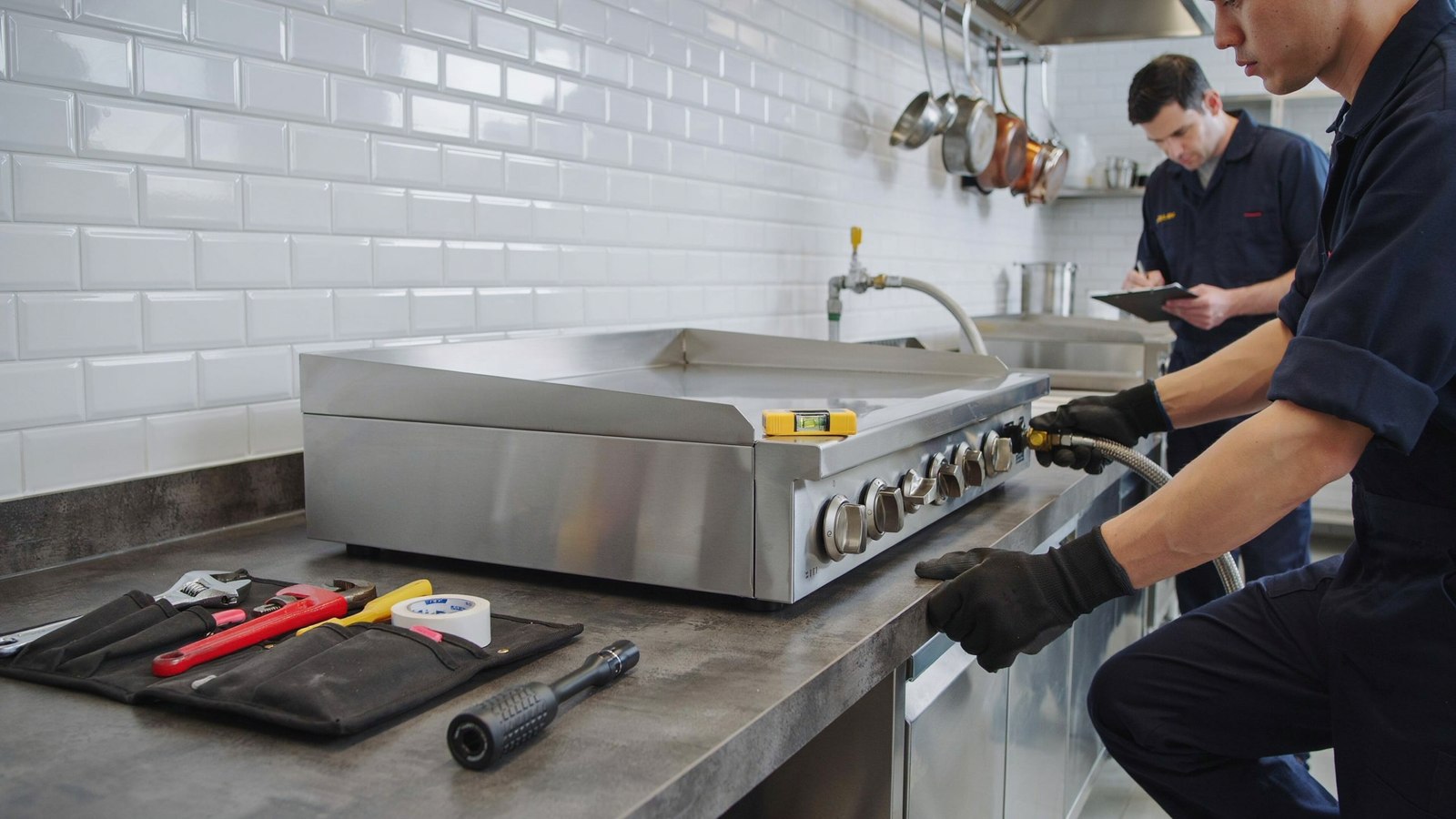
For operators, this means: a CE-compliant gas fry top is an important foundation, but it does not replace professional installation. Gas connection, extraction and placement should always be carried out and approved by a qualified installer. If you are redesigning your kitchen, you can plan space requirements and connections in advance with the free 3D kitchen planner.
What advantages does a fry top with CE certificate offer?
- Documented safety: The appliance meets the relevant EU safety requirements.
- Legal protection: You use an appliance that is approved for the EU market.
- Traceable documentation: Technical data, manual and declaration of conformity make maintenance, repairs and inspections easier.
- Better planning: Connection ratings and gas type are clearly stated, which simplifies installation and kitchen planning.
- Trust among team and guests: Safe and clean equipment is part of professional kitchen management.
How do I recognise a fry top with CE certificate?
The CE mark is usually found on the rating plate of the appliance. It consists of the letters "CE" in a prescribed design. The rating plate also states the manufacturer, model designation, connection ratings and, for gas appliances, the gas type and appliance category.
Purchase checklist
- Check the CE mark and the rating plate on the appliance.
- Request operating instructions in German.
- Ask the dealer or manufacturer for the EU declaration of conformity.
- For gas appliances, compare the gas type and supply pressure with your installation.
- For electric appliances, clarify the voltage and fusing (for example 230 V or 400 V).
You will find suitable commercial kitchen equipment in the iGastroNomic range. If you have questions about connection ratings or documentation, our personal consultation can help.
Conclusion
CE certification is an indispensable feature for fry tops in professional catering. It shows that the manufacturer meets the EU requirements for safety, health and environmental protection and that the appliance may be lawfully placed on the market. However, it is not a quality guarantee, but a minimum standard.
When buying, pay attention to the CE mark, the rating plate, the operating instructions and the declaration of conformity. For gas appliances, you should also insist on professional installation and approval. This way your kitchen works efficiently, safely and in compliance with regulations.
FAQ – Frequently Asked Questions
What does CE certification mean for a fry top?
The CE marking means that the manufacturer confirms, with a declaration of conformity, that the fry top meets the relevant EU requirements for safety, health and environmental protection. It is not a quality label or an independent test seal, but a prerequisite for the appliance to be sold on the European market. For gas appliances, a notified body is usually involved.
How do I recognise a CE-compliant fry top?
Look for the CE mark on the rating plate, which also shows the manufacturer, model designation, connection ratings and, for gas appliances, the gas type. In addition, operating instructions in German and, on request, an EU declaration of conformity should be available. Ask the dealer specifically for these; reputable suppliers provide these documents.
Does a gas fry top require more documentation than an electric one?
Generally, yes. Gas appliances fall under the Gas Appliances Regulation, which usually requires an EU type examination by a notified body. Electric fry tops mainly fall under the Low Voltage and EMC Directives, where the manufacturer can often assess conformity itself. In addition, gas appliances must be professionally installed; clarify this with a qualified installation company.
May I operate a fry top without a CE mark in a commercial kitchen?
This is not advisable. Appliances without a CE mark generally may not be newly placed on the market in the EU, and in the event of damage there may be problems with insurance and liability. This is not legal advice: clarify individual cases, such as used appliances, with your authority, your insurer or a qualified specialist company.