Deutsch
 Türkçe
 Italiano
 Nederlands
 Français
 Español
 Polski
 Čeština
 Svenska
 Português PT
 Русский
 اللغة العربية
 中文
 日本語
 Tiếng Việt
 ภาษาไทย
 Română
 ελληνικά
 Magyar
 Dansk
 Suomi
 Hrvatski
 български език
 Eesti keel
 Latviešu valoda
 Slovenčina
 Slovenščina
 Bosanski
 עברית
 हिन्दी
 Bahasa melayu
 Kiswahili
 Bahasa Indonesia
 Papiamento
 Bokmål
 Lietuvių kalba
 Українська
 српски
 Shqip


 ›
 ›
 ›
 ›
 ›
 ›
 ›
 ›
 ›
 ›
 ›
 ›
 ›
 ›
 ›
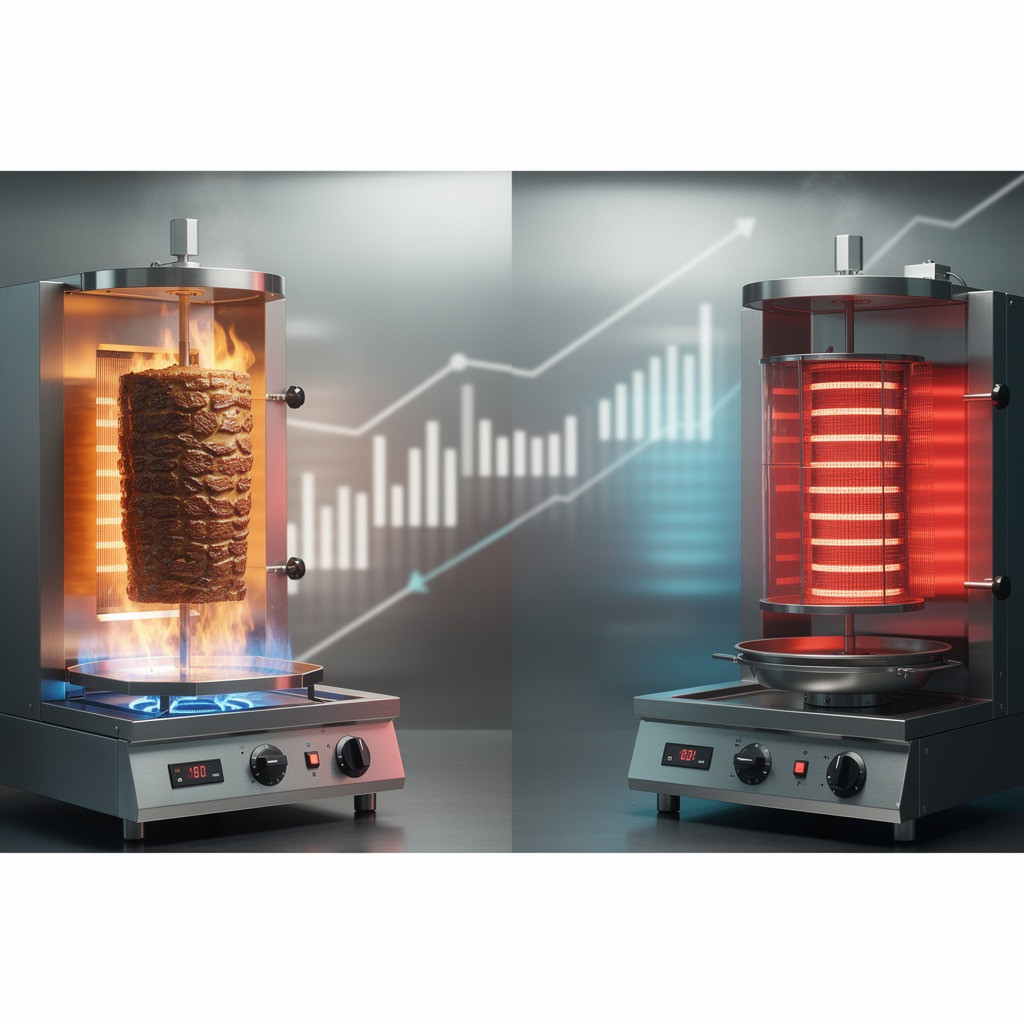
In short: For doner grill energy consumption, gas appliances are usually cheaper to run at typical energy prices, because one kWh of gas costs noticeably less than one kWh of electricity. Electric grills convert energy with higher efficiency and score on safety and indoor use, but cause higher ongoing costs. Your local tariffs, utilisation and installation location are the deciding factors.
Why is doner grill energy consumption so important?
The doner grill is the centrepiece of many snack bars, restaurants and food trucks. It has to reach high temperatures and hold them steadily for hours so that the meat cooks evenly. This makes it one of the more energy-intensive appliances in the kitchen.
Energy costs have a direct impact on profit margins, especially when energy prices fluctuate. If you know your consumption, you can reduce costs in a targeted way.
The choice between gas and electricity also affects your carbon footprint, ease of use, safety and maintenance effort. A well-founded comparison helps you make the economically sound decision.
Basics: How gas and electric doner grills work
Gas doner grills
Gas doner grills run on liquefied petroleum gas (e.g. propane or butane) or natural gas. The burners generate the heat that cooks the meat from the outside. The temperature is regulated via the gas supply.
Gas appliances are usually quick to get ready for use and offer high heating output. A typical example is a gas doner grill with 4 burners for larger quantities of meat.
Electric doner grills
Electric doner grills use heating coils or infrared emitters. The heat is released evenly and is easy to control.
Electric appliances are usually easier to clean and can be used where gas operation is restricted. One example is the electric doner grill with 4 burners.
Energy consumption compared: gas vs. electricity
Typical power consumption
- Gas grills: Burner output is often between 5 and 15 kW, depending on size and number of burners.
- Electric grills: Electrical power is usually between 3 and 10 kW.
At first glance, gas grills seem more powerful. For consumption, however, what matters is how much of the energy used actually reaches the meat as useful heat.
Efficiency and energy efficiency
Efficiency describes how much of the energy used is converted into usable heat. As a rough guideline, gas grills reach about 60–70%, because heat is lost through exhaust gases and radiation. Electric grills achieve figures of up to 90%, since the heating elements release their heat directly.
A gas appliance with a 12 kW rated output delivers about 7.8 kW of useful heat at 65%. An electric appliance with 7 kW delivers about 6.3 kW at 90%. Electric grills therefore have lower total output but use energy more efficiently. However, one kWh of electricity usually costs more than one kWh of gas.
Sample calculation: energy use per operating hour
For a fair comparison, we assume the same useful heat output, here 6 kW. The values are guideline figures and vary depending on model, utilisation and settings.
| Appliance type | Useful heat | Efficiency (guideline) | Energy input per hour | Cost per hour (assumption) |
|---|---|---|---|---|
| Gas doner grill | 6 kW | approx. 65% | approx. 9.2 kWh gas | approx. €1.11 at €0.12/kWh |
| Electric doner grill | 6 kW | approx. 90% | approx. 6.7 kWh electricity | approx. €2.33 at €0.35/kWh |
As a rule of thumb, one cubic metre of natural gas contains around 10 kWh. For liquefied petroleum gas, use the energy content stated by your supplier or on your bill.
Cost comparison: gas vs. electricity
Energy prices as calculation assumptions
The following prices are example values for the calculation, not a forecast. Check your current tariffs, as they vary by region, provider and contract.
- Gas: approx. €0.10 to €0.15 per kWh
- Electricity: approx. €0.30 to €0.40 per kWh (sometimes lower for commercial customers, but usually still above the gas price)
Operating costs per hour
- Gas doner grill: 9.2 kWh × €0.12 ≈ €1.11
- Electric doner grill: 6.7 kWh × €0.35 ≈ €2.33
Electric grills work more efficiently, but in this calculation the higher electricity price clearly outweighs that advantage.
Monthly and annual costs
At 8 hours a day and 26 operating days per month, this gives 208 operating hours:
- Gas: approx. €1.11 × 208 h ≈ €230 per month, around €2,760 per year
- Electricity: approx. €2.33 × 208 h ≈ €485 per month, around €5,820 per year
In this example, the difference is roughly €3,000 per year. Since grills rarely run at full load all the time, real costs are usually lower. With the energy cost calculator for commercial kitchen equipment, you can enter your own tariffs and operating hours.
Other factors in choosing an appliance
Environmental aspects
Gas is a fossil fuel and releases CO₂ when burned. Natural gas is considered relatively clean compared with other fossil fuels. Electricity, on the other hand, can come from renewable sources and can significantly reduce your ecological footprint.
If sustainability is important to you, factor the origin of your electricity into the decision.
Ease of use and safety
- Gas grills: Fast heat-up time, but the open flame requires special safety precautions.
- Electric grills: Simpler operation, no open flame and a lower risk of accidents.
Maintenance and service life
Gas appliances need regular checks of burners and gas lines. Electric grills often require less maintenance but can be more expensive to repair if they fail.
Service life depends on quality, use and care and is typically between 5 and 15 years.
Tips for reducing operating costs
Choose efficient appliances
When buying, look for high efficiency and modern technology. Newer models often offer better insulation and more precise temperature control, which saves energy.
Maintain and clean regularly
Clean burners and heating elements ensure optimal heat transfer. Clogged nozzles or dirty heating surfaces increase energy consumption.
Optimise operating times
Avoid unnecessary preheating and switch the grill on only when it is really needed. Match the amount of meat on the spit to demand.
Reduce heat loss
Good insulation and closed appliance doors, where fitted, reduce heat loss and lower energy requirements.
Check alternative energy and funding options
Where possible, source electricity from renewable sources or check whether switching to biogas is an option. Some regions offer funding programmes for energy-efficient kitchen equipment or renewable energy. Ask authorities or energy suppliers, as conditions change.
Which doner grill suits which business?
| Criterion | Gas doner grill | Electric doner grill |
|---|---|---|
| Ongoing energy costs | usually lower | usually higher |
| Efficiency (guideline) | approx. 60–70% | up to approx. 90% |
| Installation location | gas connection or cylinder, extraction required | adequately sized power supply |
| Safety | open flame, precautions required | no open flame |
| Typical use | high-utilisation businesses | indoor areas, smaller businesses, strict regulations |
You can find an overview of sizes and versions in our gyros and doner grills in the shop. For large businesses with high energy demand, gas is often the more economical choice. Smaller businesses or locations with strict safety requirements often benefit more from electric appliances.
Conclusion
Gas doner grills are generally cheaper to run, mainly because of lower energy costs per kWh. Electric grills stand out for higher efficiency, better controllability and safety advantages, but they cause higher electricity costs.
The decision depends on business size, location, environmental priorities and safety requirements. Regardless of the appliance type, efficient technology, regular maintenance and well-planned operating times reduce costs in the long run.
iGastroNomic offers free advice on this. Use our personal consultation or call us at +49 (0) 6135 7040 450.
FAQ – Frequently Asked Questions
Is a gas or electric doner grill cheaper to run?
At typical energy prices, a gas doner grill is usually cheaper to run, because one kWh of gas costs noticeably less than one kWh of electricity. Electric grills use energy more efficiently but rarely make up for the price difference. Your tariffs, utilisation and whether gas is permitted at your site are the deciding factors.
Can I convert my gas doner grill to electricity?
No, converting a gas appliance to electricity or vice versa is not technically sensible, because the heating system, controls and connections are fundamentally different. Buying a new appliance is usually more economical. Switching between gas types, for example from natural gas to liquefied petroleum gas, is possible on some appliances using a nozzle set and should be carried out by a qualified specialist.
Are electric grills better suited for indoor use?
Yes, electric grills are often the simpler choice for indoor areas, as they need no open flame and no gas line. Extraction and safety requirements can also be lower. Even so, they need a adequately sized power supply and an extractor hood. Clarify the requirements for your site in advance with a qualified contractor and the responsible authority.
How can I measure the energy consumption of my doner grill?
For electric grills, measure consumption with a sub-meter installed by a qualified electrician, or with a plug-in energy meter for plug connections. For gas appliances, read the gas meter before and after operating hours or use a sub-meter. Measure over several days so that typical utilisation and peak loads are realistically reflected.
How long does a doner grill last on average?
The service life of a doner grill depends on quality, use and care and is typically between 5 and 15 years. Regular cleaning, checking of burners or heating elements and professional maintenance noticeably extend its useful life. For gas appliances, regular inspection of the gas supply by qualified personnel is also required.