Deutsch
 Türkçe
 Italiano
 Nederlands
 Français
 Español
 Polski
 Čeština
 Svenska
 Português PT
 Русский
 اللغة العربية
 中文
 日本語
 Tiếng Việt
 ภาษาไทย
 Română
 ελληνικά
 Magyar
 Dansk
 Suomi
 Hrvatski
 български език
 Eesti keel
 Latviešu valoda
 Slovenčina
 Slovenščina
 Bosanski
 עברית
 हिन्दी
 Bahasa melayu
 Kiswahili
 Bahasa Indonesia
 Papiamento
 Bokmål
 Lietuvių kalba
 Українська
 српски
 Shqip


 ›
 ›
 ›
 ›
 ›
 ›
 ›
 ›
 ›
 ›
 ›
 ›
 ›
 ›
 ›
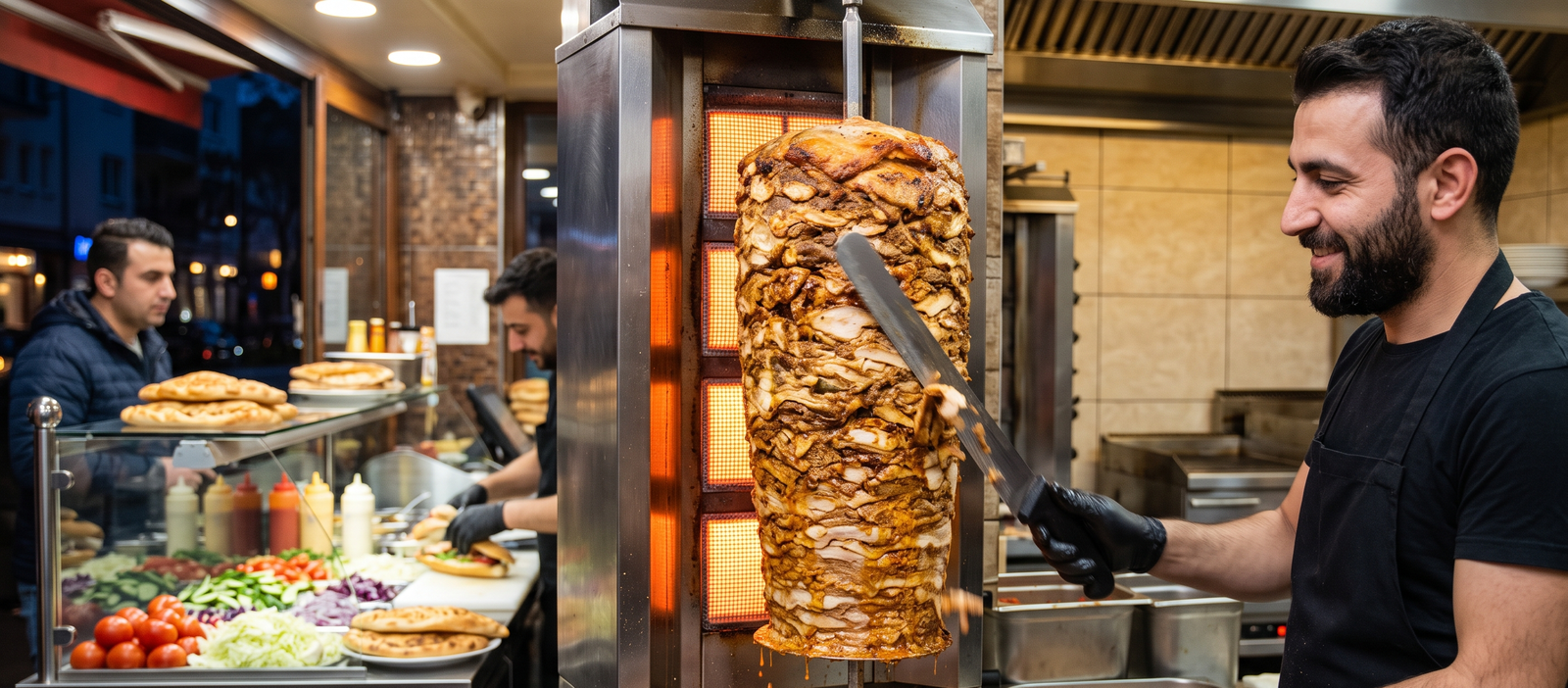
In short: Grilling doner meat vertically has a clear purpose: the rotating spit cooks all meat layers evenly, lets fat and meat juices drip off, and means you only ever slice the fully browned outer layer. For foodservice operators, this means fresh portions in a short time, consistent quality and a small footprint. The vertical grill, also called a rotisserie grill, works with a gas or electric heat source directly in front of the spit.
What is a vertical grill?
A vertical grill, also called a rotisserie grill or doner grill, is a grilling appliance in which the meat sits on a vertical spit that rotates slowly. The heat source is located at the side or behind the meat, usually as a gas burner or electric heating element. The rotation browns the meat evenly and creates the typical crust.
This differs fundamentally from horizontal grilling, where the food rests on a grate above or below the heat source. The vertical grill is designed for large pieces of meat cooked on a spit, such as doner, gyros or shawarma. The range of gyros and doner grills extends from compact units to large models for high sales volumes.
How the vertical grill works
Structure of the spit
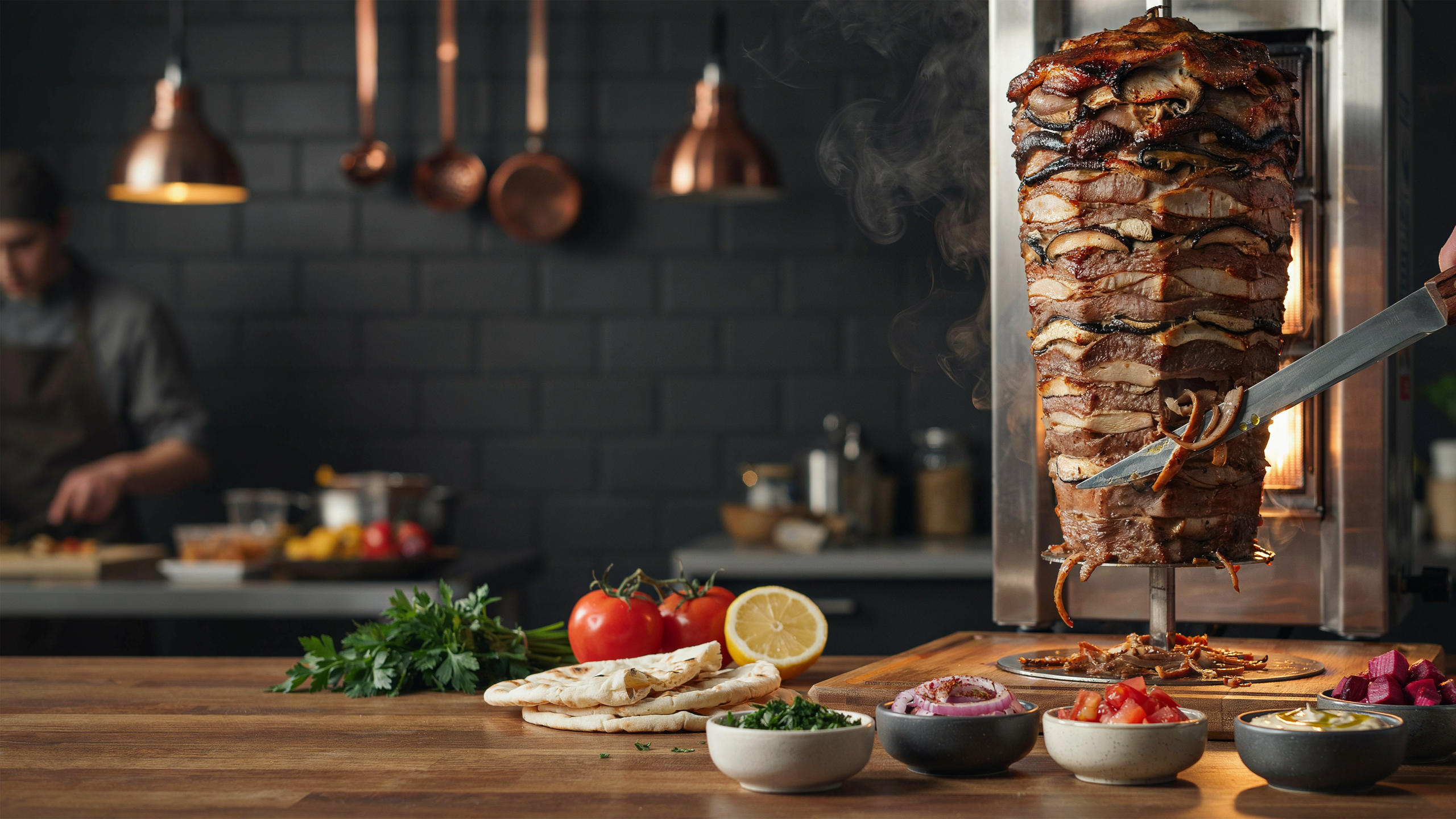
The meat is placed in thin layers or as a prepared spit onto a long, vertical skewer. The spit rotates slowly in front of the heat source. The heat acts on the meat from the outside, and the rotation ensures that all sides are heated evenly.
Cooking and the Maillard reaction
On the surface, the Maillard reaction creates an aromatic, brown crust. Amino acids and sugars react with each other under heat, which is responsible for color and intense flavor. The inside of the spit cooks more slowly and therefore stays juicy.
Slicing off the cooked layer
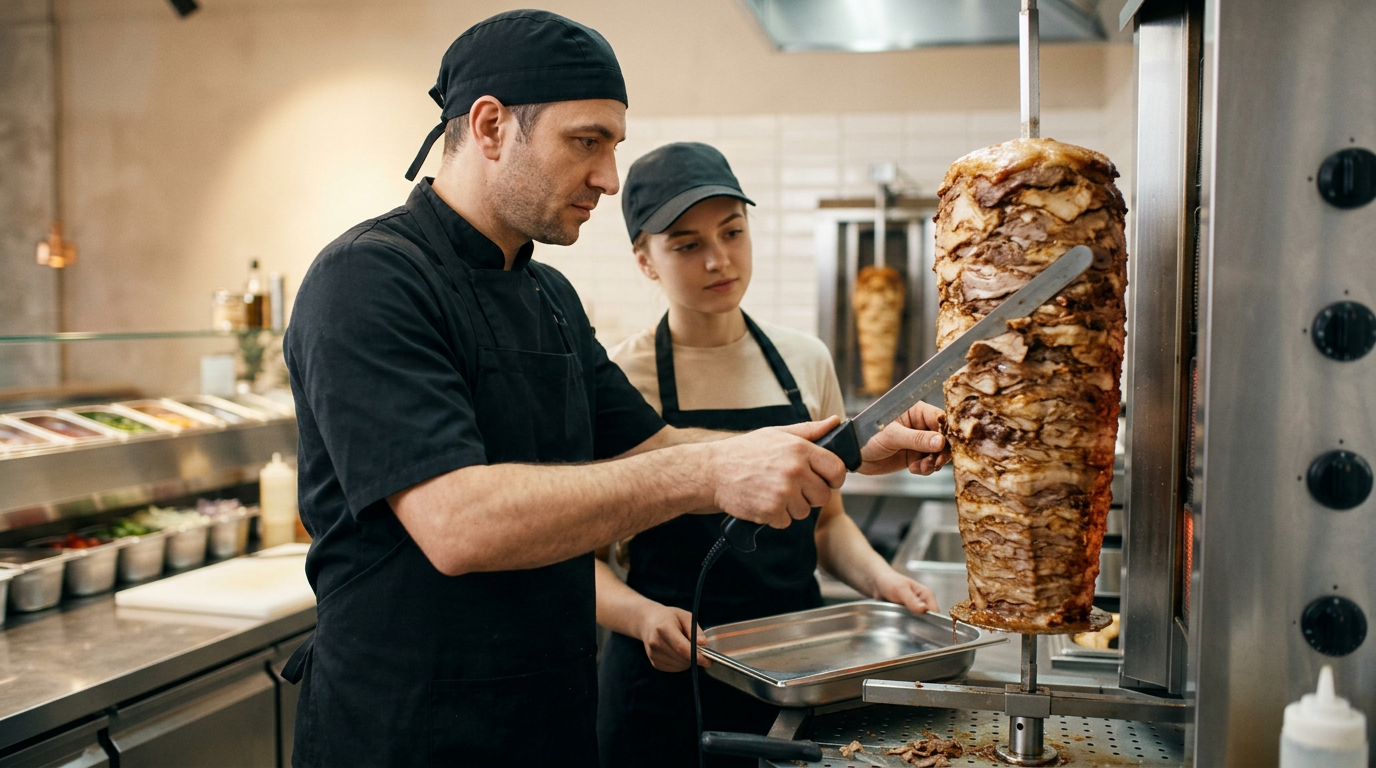
The outer, fully cooked layer is sliced off with a sharp knife or an electric doner knife. This way, only well-browned pieces end up in the bread or on the plate, while the layer underneath continues to cook. This continuous process is a main reason why the vertical grill works so well in snack bars.
Why vertical? The benefits of vertical grilling
Even heat distribution
Thanks to the rotation, all sides of the spit receive heat in turn. With horizontal grilling, hotter and cooler zones arise more easily. The vertical grill therefore delivers a more even cooking result across the entire surface.
Juiciness and flavor
With vertical grilling, fat and meat juices run downward. The meat therefore does not cook in its own fat, but stays juicy and aromatic. At the same time, the heat from the side forms the desired crust.
Energy efficiency
The heat is directed specifically at the spit, so no large grate or grill surface needs to be heated. The constant rotation uses the heat evenly. How economical a unit is in daily operation depends on its design, output and operating hours.
Hygiene and cleaning
Because fat and meat juices run downward, they collect in the drip tray and not on a grilling surface. This makes cleaning easier and can reduce the risk of grease fires. Regular emptying and cleaning remain essential nonetheless.
Space requirements and practical use in foodservice
A vertical grill requires little floor space and fits well even in small snack bars or doner shops. It enables continuous preparation: meat is sliced off at the bottom while new meat cooks at the top. To test how best to integrate the unit into your kitchen in advance, you can use the free 3D kitchen planner.
Appearance and customer experience
The rotating spit is an eye-catcher. Guests see the meat cooking fresh, which builds trust and whets the appetite. The shape of the doner spit has become a worldwide symbol of doner shops.
Technical features of a vertical grill
Modern units offer various functions that make the cooking process controllable:
- Gas or electric heating: Depending on the model, gas burners or electric heating elements are used. Gas typically heats up quickly, while electric units are usually easier to regulate and clean.
- Rotation motor: The motor turns the spit evenly. On many units, the rotation speed can be adjusted to the type of meat and spit size.
- Heat control: Depending on the design, burners or heating levels can be set separately so that the heat matches the spit.
- Grease drip tray: It collects dripping fat and meat juices and makes cleaning easier.
- Lighting: On many models, it keeps the spit clearly visible.
- Swing doors and mobile base: Some units are movable and have doors behind which accessories and gas or technical components are stored protected.
Gas or electric: which doner grill fits?
The choice of energy type depends mainly on the on-site connections and the intended use. The following table shows typical differences:
| Criterion | Gas doner grill | Electric doner grill |
|---|---|---|
| Heating up | Typically ready for use quickly | Depends on output, usually evenly heated |
| Connection | Gas supply or bottled gas, suitable extraction | Adequately dimensioned power supply |
| Control | Burners individually adjustable | Heating levels usually finely adjustable |
| Cleaning | Consider burners and surroundings | Usually easier |
| Typical use | Snack bars, doner shops, also mobile with gas supply | Restaurants and businesses without gas connection |
A gas doner grill with 4 burners is suitable for large spits of up to about 60 kg. If you work without a gas connection, the electric doner grill with 4 burners offers an alternative in the same size class. Both are mobile and equipped with swing doors.
Benefits for foodservice at a glance
- Fast preparation: Thanks to rotation and slicing off the outer layer, doner can be served quickly and fresh.
- Consistent quality: Even heat ensures a reliably uniform result.
- Cost efficiency: Targeted heat management and draining of fat can reduce operating costs and effort.
- Flexibility: Different types of meat and marinades can be processed.
- Attractive presentation: The visibly cooking spit draws attention.
Practical tips for operation
- Place the spit straight and centered so that it rotates evenly.
- Set the distance to the heat source and the burner levels so that the crust browns without burning.
- Slice off only the cooked outer layer and give the spit time to continue cooking in between.
- Match the spit size to daily sales so that meat does not stand unnecessarily long.
- Empty the drip tray regularly and clean the unit thoroughly after operating hours.
- Observe hygiene requirements and your operational HACCP concept, for example regarding cooking times and temperatures.
History and cultural background
Grilling meat on a vertical spit has its roots in the Middle East and the Ottoman Empire. Dishes such as doner kebab and shawarma originated there. Related variants such as gyros belong to Mediterranean cuisine.
In Germany, doner became widely known mainly through Turkish immigrants, who began offering it in snack bars from the 1970s onward. Today, vertical grilling technology is an established part of street food culture worldwide.
Conclusion
Vertical grilling of doner meat is more than tradition. It combines even cooking, juiciness, easy cleaning and space-saving operation in a proven technique. For snack bars, doner shops and restaurants, the vertical grill is therefore the obvious solution for fast, fresh portions.
Which model suits your business depends on spit size, energy type and available space. At iGastroNomic, you receive personal advice and free kitchen planning.
FAQ – Frequently Asked Questions
Why is doner meat grilled vertically?
With vertical grilling, the spit rotates in front of the heat source so that all sides receive heat evenly. Fat and meat juices drip downward, the outer layer browns well and the inside stays juicy. In addition, only the cooked layer needs to be sliced off, while the meat behind it continues to cook. This is ideal for fast sales.
What is the difference between a gas and an electric doner grill?
Gas units typically heat up quickly and do not require a high electrical connected load, but they need a gas supply or bottled gas and suitable extraction. Electric units are usually easier to regulate and clean, but they require an adequately dimensioned power supply. Which variant fits depends on location, connections and spit size.
How much meat fits on a doner spit in a foodservice business?
This depends on the unit. Commercial doner grills are designed for different spit weights; for mobile units with three to four burners, typical maximum values are around 45 to 60 kg. Choose the size according to your daily sales: a spit that is too large stands for longer, while one that is too small has to be replaced more often.
What should I consider when planning a doner grill in the kitchen?
Plan floor space, extraction above the unit, gas or power connection, distance to flammable surfaces and clear work paths. The cutting station should also be easily accessible. Clarify requirements for extraction and fire protection with the responsible authority or a specialist company before ordering the unit.