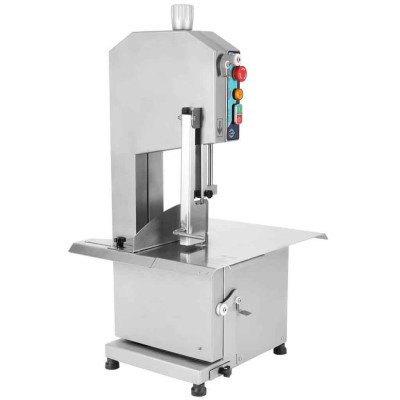
A bone saw is a band saw for food: a continuous saw blade cuts bones, chops, frozen blocks, fish and whole cuts precisely and without splinters. In butchers, meat processing, kebab production and large kitchens it replaces the cleaver and hand saw and delivers even slices, for example for T-bone steaks, shanks or soup bones.
Sizes
Blade length 165 cm – compact countertop units for kitchens and small butchers.
Blade length 200–250 cm – larger cutting heights and openings for butchers and production.
Motor output of about 0.75 to 2 kW; small models on 230 V, larger ones on 400 V.
Safety and features
Look for an adjustable blade guard, a sliding table or carriage, a cutting guide for even slice thickness, an emergency stop, door interlock and a stainless steel table. A scraper keeps the blade clean, a tray collects bone dust. Replacement blades should be easy to change and tension.
Hygiene and care
Clean blade, table, scraper and interior after every use; on good machines the housing opens wide. Check blades regularly and change them when blunt – a sharp blade cuts cleaner and safer.
Checklist
Blade length and maximum cutting height
230 V or 400 V
Cutting guide, sliding table, safety features
Availability of replacement blades
For further processing see meat mincers, slicers and refrigerated counters. iGastroNomic delivers at trade prices throughout Europe and advises you personally by phone and WhatsApp.
Frequently asked questions
What is a bone saw used for?
For cutting bones, chops, shanks, frozen meat, fish and whole cuts into even slices – cleanly, quickly and without bone splinters.
Which blade length is right?
165 cm is enough for kitchens and small butchers. For larger cuts and higher cutting heights, machines with a 200 to 250 cm blade make sense.
Do I need three-phase power for a bone saw?
Compact saws run on 230 V. Larger models with a stronger motor need 400 V. You will find this on each product.
How often should the saw blade be changed?
It depends on use and material. If the cut becomes rough or needs more force, the blade is blunt and should be replaced. Keep spare blades in stock.
Bone Saws for Butcher Shops & Foodservice
Bone saws are electric band saws that allow butchers, chefs and meat processing businesses to cut frozen and fresh meat, including the bone, cleanly and with little effort. They are designed for butcher shops, foodservice and commercial kitchens. When buying, the key factors are motor power, saw blade length, stainless steel construction and safety features.
What do you need a bone saw for?
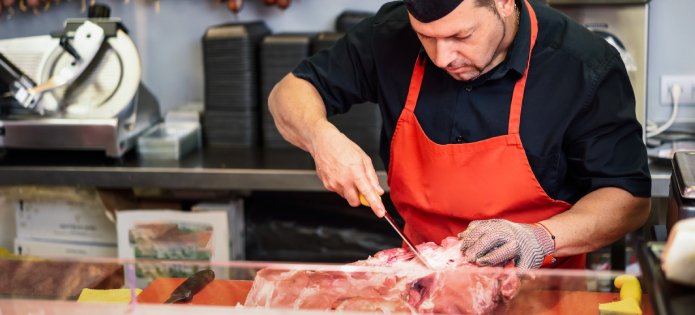
If you regularly portion beef halves, pork chops, shanks or spare ribs, a knife quickly reaches its limits. A bone saw for the butcher shop cuts through bone and frozen goods evenly, without splinters and without great effort. This saves time, increases yield and ensures uniform portions that sell well.
The unit also pays off in restaurants and hotels that prepare their own meat. If you buy meat whole, you save costs and decide cut thickness and trimming yourself. Applications range from on-farm slaughter through the butcher counter to staff canteens and catering.
Overview of applications
Butcher shop and meat market: cutting chops, steaks, shanks and soup bones
Restaurant and hotel kitchen: portioning bone-in meat and preparing stocks
Commercial kitchen and canteen: processing large quantities at consistent quality
Meat cutting plant and game processing: dividing halves, legs and frozen blocks
Fish processing: separating bones and firm fish parts
Buying advice: motor power and saw length
The most important criteria are motor power and saw length. A unit with 1.5 kW handles daily use in butcher shops and restaurant kitchens reliably. The saw length determines how large the cut product can be: models with 165 cm saw length suit most businesses, while variants with 204 cm saw length are suited to larger pieces and higher throughput.
Also check the power supply and the available space. Factor in the travel range of the meat pusher and a comfortable working surface. If in doubt, choose somewhat more power, as reserves protect the motor and the saw blade.
Comparison of variants
Variant
Typical use
Special feature
Meat bone saw 1.5 kW
Butcher shop, restaurant kitchen
Powerful motor for daily use
Electric bone saw, 165 cm saw length
Foodservice, small to medium butcher shop
Meat pusher included
Electric bone saw, 204 cm saw length
Commercial kitchen, meat cutting plant
Longer saw blade, meat pusher included
Material, hygiene and safety
Professional bone saws are made of stainless steel. The material is rust-free, resists grease and cleaning agents, and meets the hygiene requirements of food processing. Smooth surfaces prevent meat residue from adhering.
The included meat pusher keeps hands away from the saw blade and guides the cut product evenly. It is a central element of occupational safety. Look for sturdy blade guards and a stable base that reduces vibration, even when cutting hard product.
Cleaning and maintenance
Clean the saw thoroughly after every working day: disconnect the unit from the mains, remove bone residue and meat fibres, and clean the table, blade guide and meat pusher with a suitable cleaner. The saw blade should be checked regularly for tension and wear. A clean, properly tensioned blade cuts more precisely, lasts longer and lowers the risk of injury.
Delivery to Germany, Austria, Switzerland and Europe
iGastroNomic delivers bone saws and other foodservice supplies quickly and reliably throughout Germany, to Austria, to Switzerland and to many countries in Europe. This applies to butcher shops, hotels, canteens and commercial businesses. As a specialist supplier of catering equipment, we will help you choose the right unit for your business.

 Deutsch
 Türkçe
 Italiano
 Nederlands
 Français
 Español
 Polski
 Čeština
 Svenska
 Português PT
 Русский
 اللغة العربية
 中文
 日本語
 Tiếng Việt
 ภาษาไทย
 Română
 ελληνικά
 Magyar
 Dansk
 Suomi
 Hrvatski
 български език
 Eesti keel
 Latviešu valoda
 Slovenčina
 Slovenščina
 Bosanski
 עברית
 हिन्दी
 Bahasa melayu
 Kiswahili
 Bahasa Indonesia
 Papiamento
 Bokmål
 Lietuvių kalba
 Українська
 српски
 Shqip









 ›
 ›
 ›
 ›
 ›
 ›
 ›
 ›
 ›
 ›
 ›
 ›
 ›
 ›
 ›